


 9 / 29

Polymer Congress 2018
Polymer Sciences
ISSN: 2471-9935
Page 29
June 04-05, 2018
London, UK
4
th
Edition of International Conference on
Polymer Science and
Technology
R
ecent progress in supramolecular chemistry leads to
Surface grafted polymer brushes refer to an assembly
of macromolecules attached with one end to a surface and
stretched away from it. The stretched conformation of the
tethered chains and their conformational freedom leads to
unique properties of the brushes and specific applications.
Conductive polymer brushes grafted from surfaces, as
examples of such structures, are very desirable for e.g.
organic photovoltaics and molecular electronics since
they would form directional nanoscale pathway for charge
transport. However, synthesis of surface-grafted conjugated
polymer brushes is still very challenging since there are no
controlled polymerization techniques easily applicable for
that purpose. We have introduced self-templating surface-
initiated polymerization (ST-SIP) leading to synthesis of
ladder-like brushes with one chain in a pair being conjugated.
Iniferter-based photopolymerization was applied to obtain
the macromonomer brushes grafted from gold surface and
containing acetylene side groups. The pre-aligned groups
subsequently reacted forming conjugated chains. Such
obtained brushes after doping exhibited high conductivity in
the direction perpendicular to the surface as showed using
conductive atomic force microscopy. The general route was
later used for synthesis of poly(thiophene)-based brushes
and polyelectrolyte conjugated structures and may be easily
applied for obtaining other polymer architectures comprising
conjugated polymers (mixed brushes, block conductive-
nonconductive brushes etc.). Using similar approach,
photoactive polymer brushes with ordered phthalocyanine
chromophores were also synthesized. Conjugated polymer
brushes based on e.g. poly(acetylene) and poly(thiophene)
with such ladder-like architecture were also shown to exhibit
long term stability in air as compared to polymer films and
brushes composed of single chains. The conjugated and
photoactive ladder-like brushes are very promising for
applications requiring high ordering of the chains and long
term stability such as organic photovoltaics, nanoelectronics
or fabrication of energy-storage devices.
Recent Publications
1. Szuwarzyński M, Kowal J and Zapotoczny S (2012) Self-
templating surface-initiated polymerization: a route to
conductive brushes. J. Mat. Chem. 22(38):20179-20181.
2. Wolski K, Gruszkiewicz A and Zapotoczny S (2015)
Conductive polythiophene-based brushes grafted from
ITO surface via self-templating approach. Polym. Chem.
6:7505.
3. Wolski K, Szuwarzyński M and Zapotoczny S (2015) A
facile route to electronically conductive polyelectrolyte
brushes as platforms of molecular wires. Chem. Sci.
6(3):1754-1760.
4. Szuwarzyński Met al. (2017) Photoactive surface‐grafted
polymer brushes with phthalocyanine bridging groups as
an advanced architecture for light harvesting. Chem. Eur.
J. 23:11239.
5. Szuwarzyński M, Wolski K and Zapotoczny S (2016)
Enhanced stability of conductive polyacetylene in ladder-
like surface-grafted brushes. Polym. Chem. 7 (36):5664-
5670.
Biography
Szczepan Zapotoczny is a Professor at Jagiellonian University in Krakow
(Poland) where he also completed his PhD in Chemistry working on synthe-
sis and photophysics of polymeric photosensitizers. He joined the group of
Professor G J Vancso (University of Twente, The Netherlands) as a Postdoc-
toral Researcher (1999-2001) working on force spectroscopy and surface
chemistry of self-assembled systems. After coming back to Poland he fo-
cused his research on amphiphilic polymers obtained using controlled radi-
cal polymerizations and formation of photoactive polyelectrolyte multilayer
films. Later on he initiated the studies on surface-grafted polymer brushes
cooperating also with Professor Vancso. His current interests focuses on
nanostructured polymeric and hybrid materials including films, brushes
(conductive, stimuli-responsive), polymer coated nanoparticles, nanocap-
sules for photochemical and biomedical applications. He is a coauthor of
100 scientific papers and 6 patents.
zapotocz@chemia.uj.edu.plSurface-grafted polymer brushes with ladder like
architecture
Szczepan Zapotoczny
Jagiellonian University, Poland
Szczepan Zapotoczny, Polym Sci 2018, Volume 4
DOI: 10.4172/2471-9935-C2-011
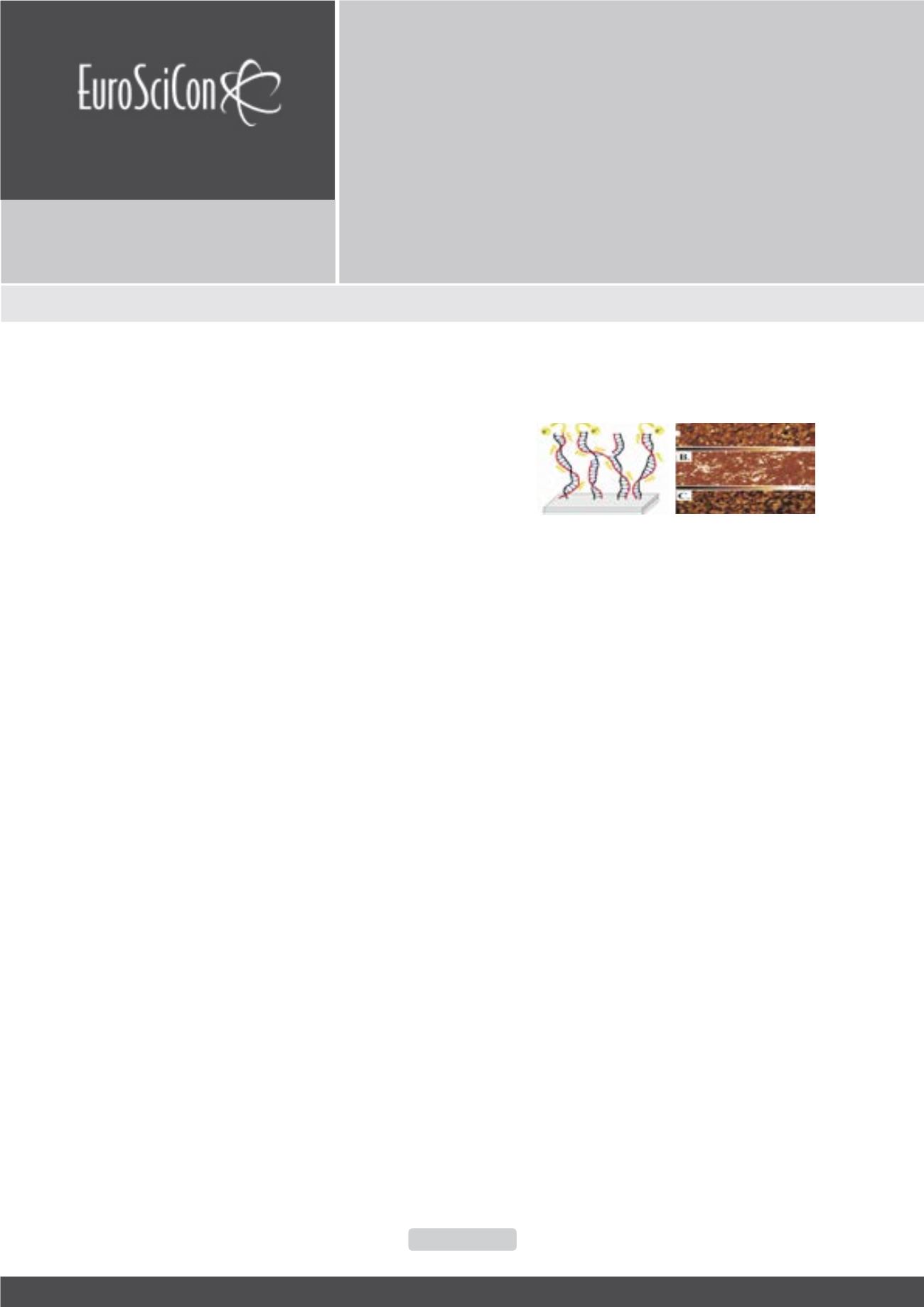
Figure 1:
: (Left) Scheme of conjugated ladder-like brusheswith ionic groups
based on pyridine. (Right) Atomic forcemicroscopy images of those brushes
captured in topography(A), current (B), and adhesion (C) modes..