



 11 / 29

Polymer Congress 2018
Polymer Sciences
ISSN: 2471-9935
Page 31
June 04-05, 2018
London, UK
4
th
Edition of International Conference on
Polymer Science and
Technology
Statement of the Problem:
Commonly, head injuries are
produced by a punctual dynamic force. When fractures are
produced, they are followed by tensile loads that generate
more fractures on other cranium areas. Prostheses have
the objective to patch a damaged area and heal the injury.
Nowadays, research is focused on customized prostheses and
there is no interest to develop a standard product to produce in
mass series. Incremental Sheet Forming (ISF) is a technology
useful to manufacture small batch or one-of-a-kind sheet
products. This paper presents the use of ISF with the aim of
manufacturing cranial prostheses in biocompatible polymeric
sheet.
Methodology:
The cranial implant is designed based on
computerized tomographies (CT) of the patient, converting
them into a 3D model using the software InVesalius. To
generate the toolpath for the forming operation Computer
Aided Manufacturing (CAM) software is employed. Once
the cranial implant is manufactured in a Kondia CNC 3 axis
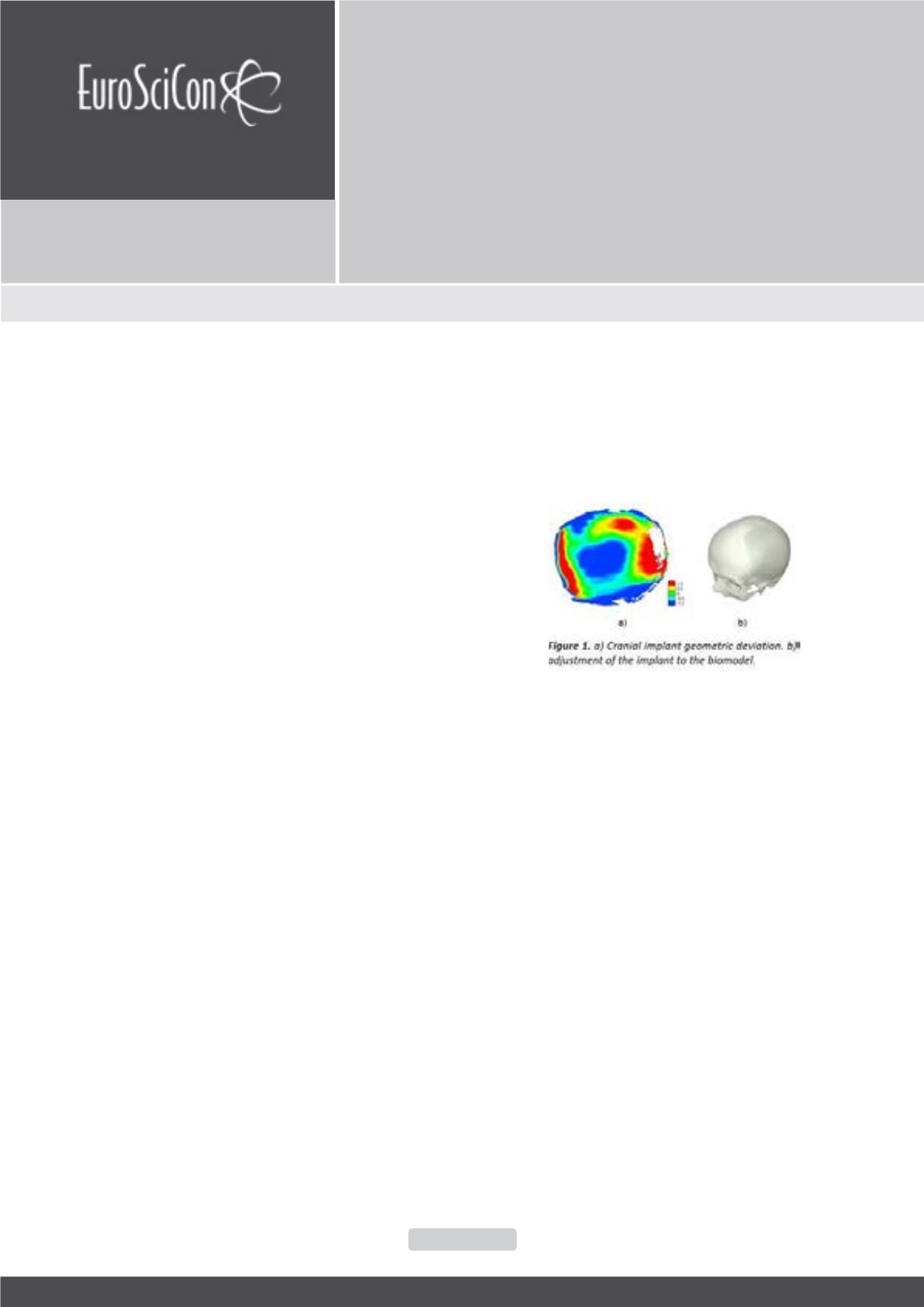
milling machine, a 3D scanning system is used to determine
the geometric deviation between the real part and the initial
design.
Findings:
The spindle speed is one of the most important
parameters that affect the results of the final part. It has been
shown that using 2000 rpm spindle speed and a negative dye
it is possible to achieve an appropriate geometric accuracy of
the prosthesis (with discrepancies below 1.5 mm) fulfilling the
standardized mechanical requirements.
Conclusions:
The use of polymeric implants in cranioplasty
is advantageously because of their lightweight, low heat
conductivity and mechanical properties similar to bone. The
results demonstrated the huge potential of manufacturing
polymeric cranial prostheses by ISF, as far as these processes
provide high formability with appropriate geometric accuracy.
Furthermore, the cost of the implant has been calculated
revealing that it is a cheap process with a low lead-time.
Recent Publications
1. SaldarriagaJF I et al. (2011) Designandmanufacturing
of a custom skull implant. American Journal of
Engineering And Applied Sciences. 4(1):169-174.
2. Bagudanch I et al. (2018) Customized cranial implant
manufactured by incremental sheet forming using a
biocompatible polymer. Rapid Prototyping Journal.
24(1).120-129.
3. Castelan J (2014) Manufacture of custom-made
cranial implants from DICOM images using 3D
printing, CAD/CAM technology and incremental sheet
forming. Brazilian Society of Biomedical Engineering.
30(3):265-273.
4. Duflou J R (2013) Manufacture of accurate titanium
cranio-facial implants with high forming angle using
single point incremental forming. Key Engineering
Materials. 549:223–230.
5. Fiorentino A et al. (2012) Rapid Prototyping Techniques
for Individualized Medical Prosthesis Manufacturing.
Proceedings Of 5th International Conference On
AdvancedManufacturingEngineeringAndTechnologies.
1:589-594. Doi: 10.1201/b11341-94.
Biography
Isabel Bagudanch is a Researcher at the Product, Process and Production
Engineering Research Group (GREP), University of Girona, Spain. Her re-
search focuses on advanced manufacturing processes such as incremen-
tal sheet forming and additive manufacturing.
isabel.bagudanch@udg.eduIncremental sheet forming for manufacturing customized
UHMWPE cranial implants
Isabel Bagudanch, Ines Ferrer
and
Maria Luisa Garcia Romeu
University of Girona, Spain
Isabel Bagudanch et al., Polym Sci 2018, Volume 4
DOI: 10.4172/2471-9935-C2-011