


 7 / 29

Polymer Congress 2018
Polymer Sciences
ISSN: 2471-9935
Page 27
June 04-05, 2018
London, UK
4
th
Edition of International Conference on
Polymer Science and
Technology
Assembly of block copolymers in 3D confined geometries
Jintao Zhu
Huahzong University of Science and Technology, China
Jintao Zhu, Polym Sci 2018, Volume 4
DOI: 10.4172/2471-9935-C2-011
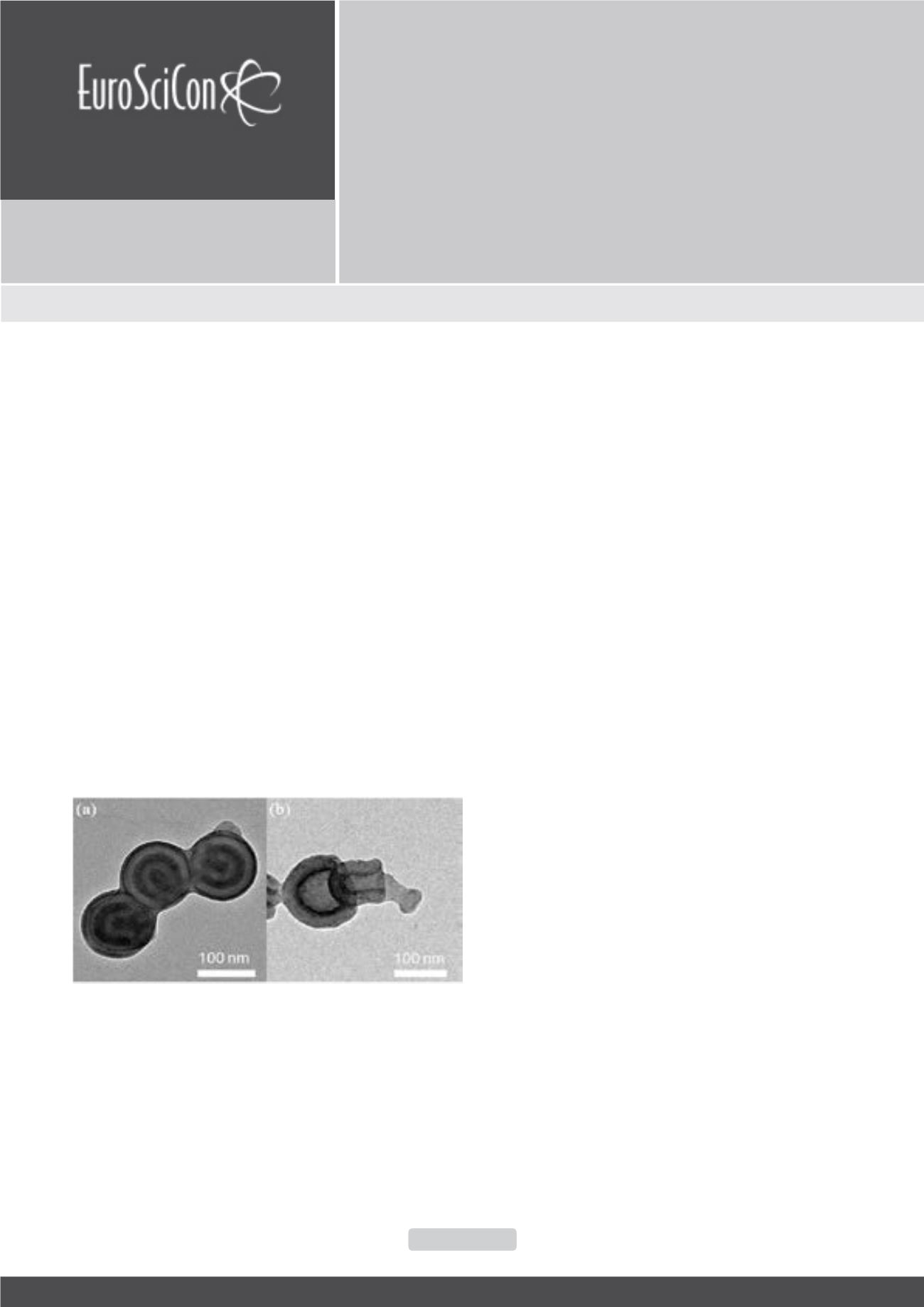
Figure 1:
TEM images of self-assembled PS-P4VP(PDP) colloidal particles (a), and corre-
sponding PS-P4VP nano-cups (b) after PDPwas removed..
B
lock copolymer assemblies have attracted great attention
due to their potential applications in the fields of drug
delivery, targeting therapy, medical diagnosing and imaging.
Three dimensional (3D) confinement, which can break the
symmetry of a structure, has proven to be a powerful route to
tailor the morphologies of block copolymer particles. Particle
shape and internal structure can thus be tuned by using the
supramolecular strategy or tailoring the interfacial interaction
of the particles with the dispersion medium. We will introduce
the generation of the nano-objects with well tunable shapes by
taking advantage of 3D confined assembly and supramolecular
chemistry. Particles with various internal structures can be
obtained due to the 3D soft confinement in emulsion droplets.
Moreover, we will show that selective disassembly of the
structured particles will give rise to mesoporous particles or
nano-objects with unique shapes, potentially useful for drug
delivery, bio-imaging, separation and diagnostics.
Recent Publications
1. J P et al. (2016) Block copolymer capsules with
structure-dependent release behavior. Angewandte
Chemie International Edition. 55(47):14633-14637.
2. Deng R H et al. (2015) Soft colloidal molecules with
tunable geometry by 3D confined assembly of block
copolymers. Macromolecules. 48(16):5855-5860.
3. Wang K et al. (2016) Electric-directed assembly
of polymer-tethered gold nanorods in cylindrical
nanopores. ACS Nano. 10(5):4954-4960.
4. Deng R H et al. (2014) Janus nanodisc of diblock
copolymers. Advanced Materials. 26(26):4469-4472.
5. Deng R H et al. (2012) Mesoporous block copolymer
nanoparticles with tailored structures by hydrogen-
bonding-assisted self-assembly. Advanced Materials.
24(14):1889-1893.
Biography
Jintao Zhu received his PhD (Polymer Chemistry and Physics) in Changchun
Institute of Applied Chemistry (CIAC), Chinese Academy of Sciences, China
in 2005. Afterwards, he carried out Postdoctoral research in the University of
Alberta, Canada and University of Massachusetts Amherst, USA. In 2009, he
joined as a Professor in the School of Chemistry and Chemical Engineering
at the Huazhong University of Science and Technology (HUST). Since 2016,
he is the Dean of the School of the Chemistry and Chemical Engineering
at HUST. His current research concentrated on confined assembly of block
copolymers and inorganic nanoparticles, responsive photonic materials,
functional polymer particles for drug delivery and imaging. He has published
over 100 papers, contributed 3 book chapters and holds 5 patents. He is a
Recipient of China National Funds for Distinguished Young Scholar (2015)
and Chinese Chemical Society Youth Awards (2013).
jtzhu@mail.hust.edu.cn