


 29 / 29
Polymer Congress 2018
Polymer Sciences
ISSN: 2471-9935
Page 54
June 04-05, 2018
London, UK
4
th
Edition of International Conference on
Polymer Science and
Technology
Synthesis and morphological insights into novel, stable and
biocompatible smart hydrogels with prospective wound healing
properties
Deepa Suhag
and
Monalisa Mukherjee
Amity University, India
Deepa Suhag et al., Polym Sci 2018, Volume 4
DOI: 10.4172/2471-9935-C2-011
A
latticeworkofhydrophilicmacromolecularstructuresresults
in the formation of hydrogels. These hydrogels are usually
synthesized by chemical or physical crosslinking strategies.
Owing to their strikingattributes such as hydrophilic nature, high
biocompatibility and flexible morphology, they are rendered as
promising candidates for potential biomedical applications.
In this current study, we present the mechanism of formation
of stable, smart, pH-responsive hydrogels via one-step, facile,
free radical aqueous copolymerization. The stability of the
hydrogels along with their predisposed macroporous structure
are attributed to the phenomenon of phase separation along
with monomer feed ratio and water content. Molecular level
evaluation further divulge the interrelation between hydrogen
bonding and strong electrolytic complexation amongst the
monomers. Furthermore, we successfully established the
remarkable biocompatibility of pAcD (poly(AAc-co-DEAEMA)).
More importantly, oral administration of the hydrogels to the
rat model did not produce any significant change in the vital
organs, namely, hippocampus (CA1 section) of the brain,
myofibrillar and myocytes nuclei of heart, hepatocytes and
central vein of liver and parenchyma, tubules and glomeruli of
kidney. Owing to their remarkable biocompatibility, stimulus
(pH) responsiveness, and cost-effective production, pAcD
hydrogels can be used for the targeted delivery and sustained
release of various pharmaceutical formulations. As a future
directive, we have also looked at the wound healing properties
of this hydrogel with herbal formulations and it resulted in
exceptionally speedy wound healing process.
Recent Publications
1. Suhag, D et al. (2017) Sustainable growth and lipid
production from Chlorella pyrenoidosa using N-doped
carbon nanosheets: unravelling the role of graphitic
nitrogen. ACS Sustainable Chemistry & Engineering.
6(1):774-780. Doi:10.1021/ acssuschemeng.7b03103.
2. Suhag D et al. (2017) Electrochemically synthesized
highly crystalline nitrogen doped graphene nanosheets
with exceptional biocompatibility. Scientific Reports.
7:537. Doi:10.1038/s41598-017-00616-8.
3. Suhag D et al. (2016) Hydrothermally functionalized
biocompatible nitrogen doped graphene nanosheets
based biomimetic platforms for nitric oxide detection.
J. Mater. Chem. B. 4(27):44780-4789. Doi: 10.1039/
C6TB01150K.
4. Suhag D et al. (2015) Hydrothermal synthesis of nitrogen
doped graphene nanosheets from carbon nanosheets
with enhanced electrocatalytic properties. RSC Adv.
5(50):39705-39713. Doi: 10.1039/C5RA05060J.
5. Suhag D et al. (2015) N-doped carbon nanosheets with
antibacterial activity: mechanistic insight. RSC Adv.
5(30):23591-23598. Doi: 10.1039/C4RA17049K.
Biography
Deepa Suhag is the Asst. Professor at Amity University, India. She has her
expertise inmaterial sciences, electrochemistry and biomimetics. Her major
efforts are focused towards exploring the biocompatibility properties of the
as-synthesized materials. Furthermore, she aims to establish the materials
synthesized by her for their prospective biomedical applications such as bi-
osensing, bio-imaging and theranostics. She aims to contribute towards the
wellbeing and uplifting of human life standards by making theranostics as
non-invasive as possible while maintaining their affordability.
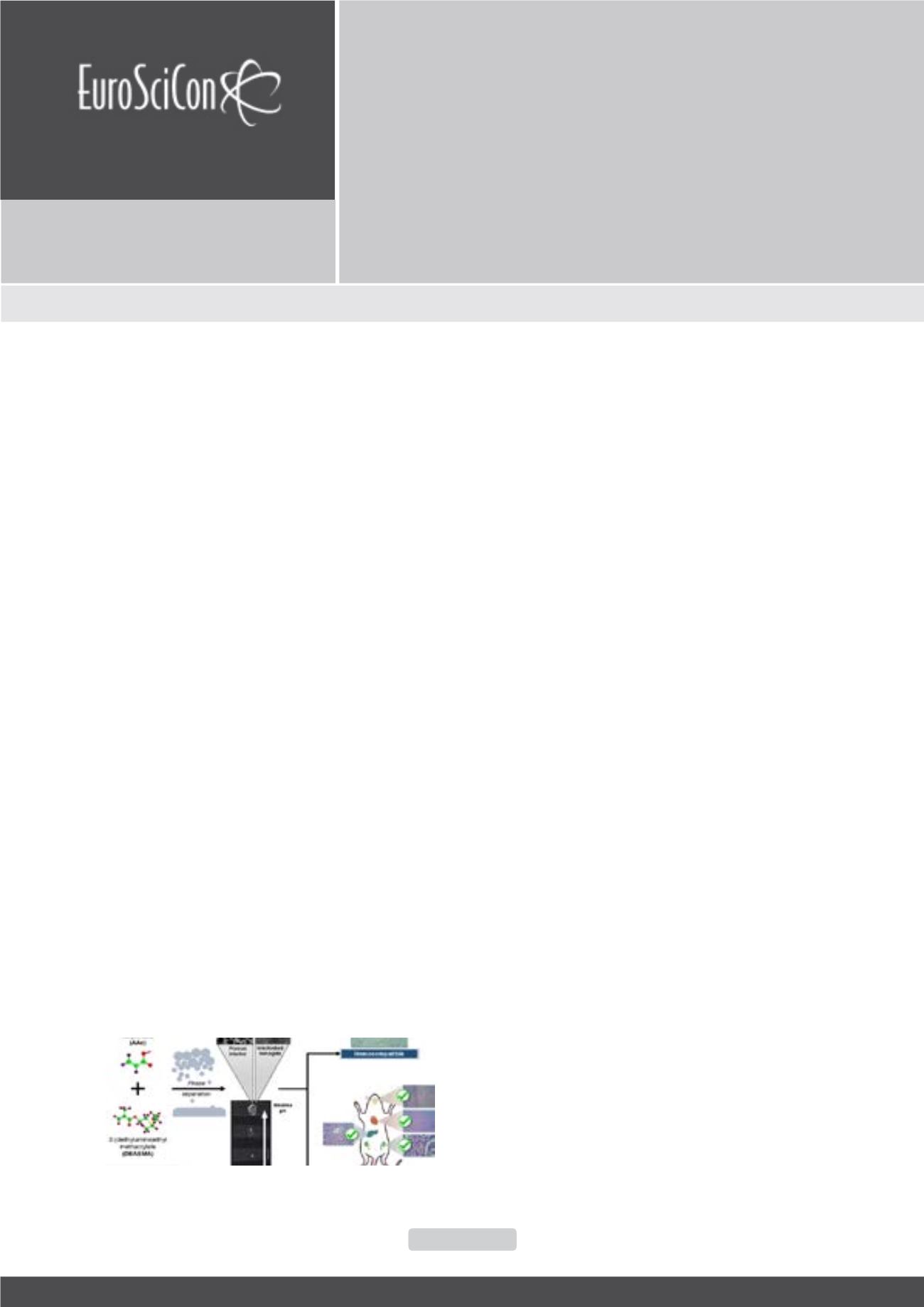
dsuhag@amity.eduFigure 1:
Macroporous interior with interlocked nanoglobules as stable
building blocks in pAcD gelswith high in-vitro and in-vivo biocompatibility.`