


 6 / 29

Polymer Congress 2018
Polymer Sciences
ISSN: 2471-9935
Page 26
June 04-05, 2018
London, UK
4
th
Edition of International Conference on
Polymer Science and
Technology
M
any organic and hybrid thin film electronic devices (e.g.
solar cells, light emitting diodes and sensors) contain a
layer of a functional or responsive material based on a blend
of polymeric or small-molecular components. Depending on
the desired functionality, phase separation between the blend
components during solution processing is desired or not.
Predictive models that establish a link between processing
dynamics and device performance have been highly desired
to avoid trial-and-error experimentation. We study solution-
stage spinodal decomposition of such blends under
evaporative conditions using a combination of experimental
and theoretical approaches. We provide an explanation for
the decrease in the early stage spinodal wavelength under
steady solvent evaporation. Scaling relations are derived
that express the dependence of the emerging structure size
and demixing time scale on evaporation rate. Besides giving
experimental examples and summarizing our linearized theory,
this contribution provides discussion on the experimental
validation of the latter and in what way the dynamics change
if instead of only one, two blend components are non-mass
conserved. This scenario arises when water vapor condenses
as a non-solvent into an evaporating polymer solution, e.g.
during processing of thin-film memory elements based on
multifluorinated polyhydrocarbons.
Recent Publications
1. Kouijzer S et al. (2013) Predicting morphologies of
solution processed polymer: fullerene blends. J. Am.
Chem. Soc. 135(32):12057-12067.
2. Van Breemen A et al. (2015) Surface directed phase
separation of semiconductor ferroelectric polymer
blends and their use in non-volatile memories. Adv.
Func. Mater. 25(2):278-286.
3. Schaefer C, van der Schoot P and Michels J J (2015)
Structuring of polymer solutions upon solvent
evaporation. Phys. Rev. E 91(2):022602.
4. Schaefer C, Michels J J and van der Schoot P (2016)
Structuring of thin-film polymer mixtures upon solvent
evaporation. Macromolecules. 49(18):6858-6870.
5. Sharifi Dehsari H, Michels J J and Asadi K
(2017) Processing of ferroelectric polymers for
microelectronics: from morphological analysis to
functional devices. J. Mater. Chem. C. 5(40):10490-
10497.
Biography
Jasper Michels completed his PhD at the University of Twente (The Neth-
erlands) in at the Supramolecular Chemistry and Technology group of Pro-
fessor D N Reinhoudt, where he received his PhD Degree in 2001. After his
graduation he held a Postdoctoral Research position for two years in the
group of Professsor H L Anderson at Oxford University, UK. In 2003 he start-
ed working at TNO Science and Industry in Eindhoven, to join Holst Centre
in 2006 as a Senior Scientist. In the period 2006-2016 he has been mem-
ber and vice-chairman of the advisory board for IOP Self-Healing Materials
program in The Netherlands. In September 2014 he joined the Department
of Molecular Electronics at the Max Planck Institute for Polymer Research
as a Group Leader. His research activities include modeling and simulation
of phase transitions in semiconducting thin films that find applications in
organic and hybrid electronics.
michels@mpip-mainz.mpg.deEvaporative structuring of solutions of active blends for
molecular electronics applications
Jasper Michels
Max Planck Institute for Polymer Research, Germany
Jasper Michels, Polym Sci 2018, Volume 4
DOI: 10.4172/2471-9935-C2-011
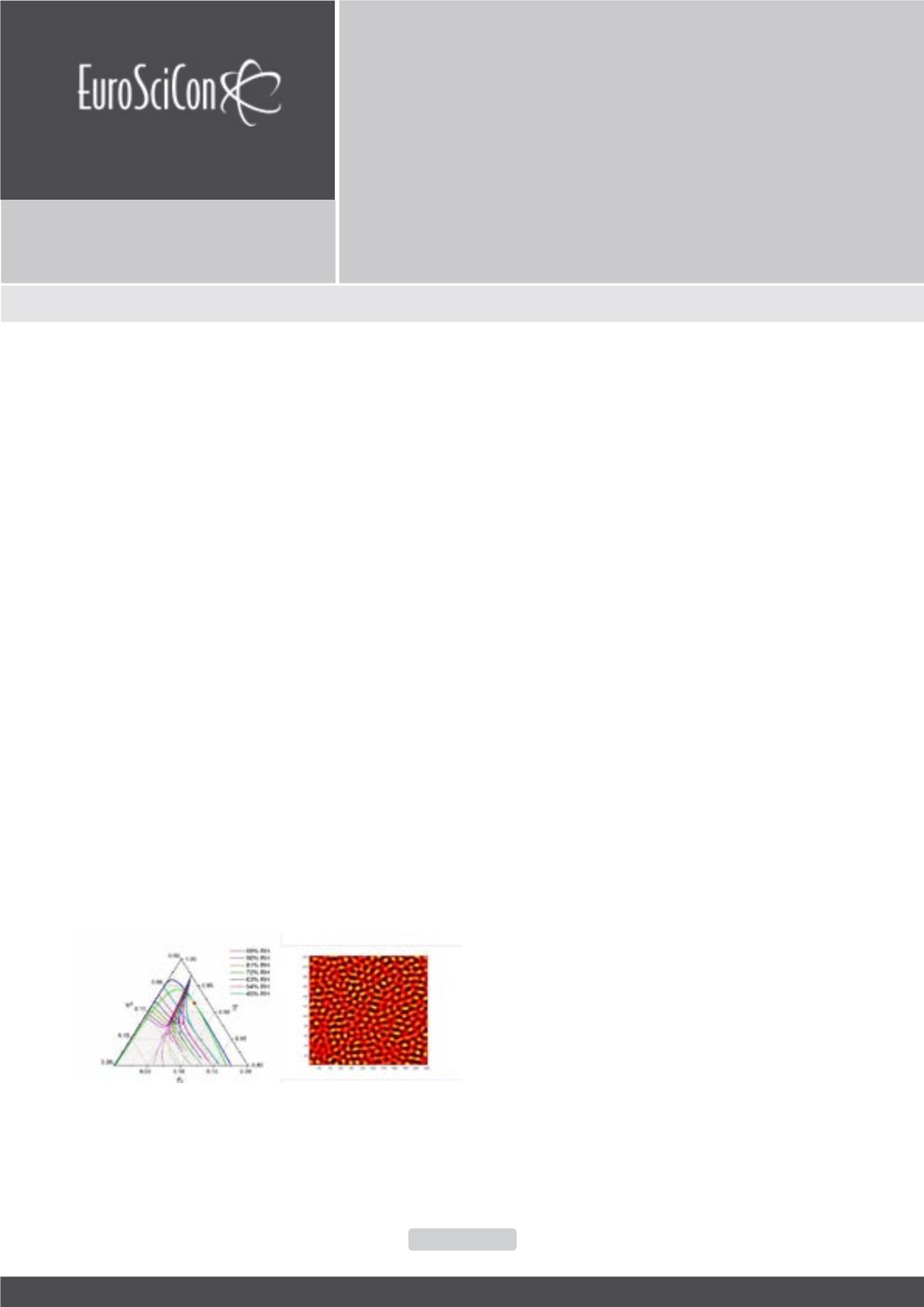
Figure 1:
Left: calculated Phase diagramof a polymer/water/solvent blendwith com-
position trajectories followed during solvent evaporation; Right: numerical simulation of
spinodal decomposition of a polymer solution under conditions of simultaneous solvent
evaporation andwater condensation.