ISSN : 2321-2748
American Journal of Phytomedicine and Clinical Therapeutics
Vitamin C Enhances the Anti-Aging Effects of Saussurea involucrata Stem Cell Extract by Extending Lifespan and Improving Mobility in Caenorhabditis elegans
1Research & Design Center, TCI CO., Ltd., 11F., No. 187, Gangqian Rd, Neihu District, Taipei 114, Taiwan
2Department of Food Science, Institute of Food Safety and Risk Management, National Taiwan Ocean University, Beining Rd, Keelung City, Taiwan
3Graduate Institute of Biomedical Engineering, National Chung Hsing University, Xingda Rd, Taichung City, Taiwan
- Corresponding Author:
- Chi-Fu Chiang
Research & Design Center, TCI CO., Ltd
11F., No. 187, Gangqian Rd, Neihu District
Taipei 114, Taiwan
Tel: +886-2-8797-7811 ext. 8827
Email: Jimmy.Chiang@tci-bio.com
Received: 23 April, 2026, Manuscript No. ipapct-26-21121; Editor assigned: 25 April, 2026, PreQC No. P-21121; Reviewed: 08 May, 2026, QC No. Q-21121; Revised: 14 May, 2026, Manuscript No. R-21121; Published: 22 May, 2026, DOI: 10.5281/zenodo.20442966
Citation: Chiang CF, Lee LS, Lin YH, Lin YK, Chan ST (2026) Vitamin C Enhances the Anti-Aging Effects of Saussurea involucrata Stem Cell Extract by Extending Lifespan and Improving Mobility in Caenorhabditis elegans. Vol. 13 No. 2: 323
Copyright: © 2026 Chiang CF, et al. This is an open-access article distributed under the terms of the Creative Commons Attribution License, which permits unrestricted use, distribution, and reproduction in any medium, provided the original author and source are credited.
Abstract
Aging is a multifactorial biological process characterized by reduced lifespan and progressive functional decline. Developing strategies that can both extend lifespan and maintain physiological function has become an important research focus. S. Involucrata Stem Cell Extract (SISCE), rich in polyphenols and flavonoids, has potential for health-related applications, while Vitamin C is a widely used functional ingredient. To evaluate the effects of SISCE alone and in combination with Vitamin C on lifespan and locomotor activity in C. elegans. Age-synchronized wild-type N2 C. elegans were randomly assigned to control, SISCE and SISCE + Vitamin C groups. Lifespan was analyzed using Kaplan–Meier survival analysis. Locomotor activity was assessed to evaluate age-related functional changes and mobility duration and decline slope were calculated. SISCE significantly increased mean lifespan from 20.16 to 23.38 days (+16.0%, p = 0.005). Co-treatment with Vitamin C further extended lifespan to 24.41 days (+21.1%, p = 0.0001). Both treatments significantly attenuated age-related decline in locomotor activity, with the combination group showing the greatest effect. Mobility duration increased from 5.1 days to 8.5 days (+66%) and the decline slope was reduced, indicating a slower rate of functional deterioration. SISCE extends lifespan and improves locomotor function in C. elegans and these effects are enhanced when combined with Vitamin C. This combination shows potential as a functional ingredient for applications in healthy aging and warrants further investigation.
Abstract
Aging is a multifactorial biological process characterized by reduced lifespan and progressive functional decline. Developing strategies that can both extend lifespan and maintain physiological function has become an important research focus. S. Involucrata Stem Cell Extract (SISCE), rich in polyphenols and flavonoids, has potential for health-related applications, while Vitamin C is a widely used functional ingredient. To evaluate the effects of SISCE alone and in combination with Vitamin C on lifespan and locomotor activity in C. elegans. Age-synchronized wild-type N2 C. elegans were randomly assigned to control, SISCE and SISCE + Vitamin C groups. Lifespan was analyzed using Kaplan–Meier survival analysis. Locomotor activity was assessed to evaluate age-related functional changes and mobility duration and decline slope were calculated. SISCE significantly increased mean lifespan from 20.16 to 23.38 days (+16.0%, p = 0.005). Co-treatment with Vitamin C further extended lifespan to 24.41 days (+21.1%, p = 0.0001). Both treatments significantly attenuated age-related decline in locomotor activity, with the combination group showing the greatest effect. Mobility duration increased from 5.1 days to 8.5 days (+66%) and the decline slope was reduced, indicating a slower rate of functional deterioration. SISCE extends lifespan and improves locomotor function in C. elegans and these effects are enhanced when combined with Vitamin C. This combination shows potential as a functional ingredient for applications in healthy aging and warrants further investigation.
Keywords
Saussurea involucrate; Vitamin C; Caenorhabditis elegans; Lifespan
Introduction
Aging is a complex and multifactorial biological process characterized of physiological functions, ultimately leading to increased susceptibility to chronic diseases and reduced quality of life [1]. At the cellular level, aging is closely associated with oxidative stress, chronic inflammation, mitochondrial dysfunction and impaired regenerative capacity [2]. These interconnected mechanisms have driven growing scientific and commercial interest in developing effective anti-aging strategies that not only alleviate symptoms but also target the underlying biological processes of aging. Current anti-aging approaches primarily focus on antioxidant supplementation, anti-inflammatory interventions and metabolic regulation. Among these, vitamin-based antioxidants such as ascorbic acid (Vitamin C) have been extensively studied due to their ability to neutralize Reactive Oxygen Species (ROS) and reduce oxidative damage [3]. However, most conventional strategies are limited by their focus on single pathways and often fail to address the broader issue of cellular regeneration and long-term tissue maintenance. As a result, there is an increasing demand for multi-functional approaches that integrate both protective and regenerative mechanisms.
Saussurea involucrata, commonly known as Tianshan snow lotus, has attracted attention as a promising natural candidate for anti-aging applications [4]. This alpine medicinal plant is rich in bioactive compounds, including flavonoids and phenolic constituents, which exhibit potent antioxidant and anti-inflammatory activities [5]. Previous studies have demonstrated that these compounds can modulate oxidative stress, suppress inflammatory signaling pathways such as NF-κB and protect cells from damage induced by environmental stressors. These multi-target effects suggest that S. involucrata may provide broader anti-aging benefits compared to conventional single-function ingredients [6]. In recent years, stem cell-based approaches have emerged as a key strategy in anti-aging research due to their ability to promote tissue regeneration and maintain cellular homeostasis [7]. Stem cells possess unique properties, including self-renewal, differentiation potential and paracrine signaling, which collectively contribute to tissue repair and functional restoration [8]. Plant-derived stem cells, in particular, offer advantages such as consistent bioactive profiles, scalability and stability, making them attractive for both research and industrial applications [9]. Therefore, integrating plant stem cell systems with bioactive compounds represents a novel direction for developing next-generation anti-aging interventions.
Vitamin C plays a crucial role not only as an antioxidant but also as a regulator of stem cell function [10]. Beyond its ROS-scavenging activity, ascorbic acid has been shown to influence epigenetic regulation through the activation of Ten-Eleven Translocation (TET) enzymes, thereby promoting DNA demethylation and enhancing gene expression associated with stem cell proliferation and differentiation [11]. Additionally, Vitamin C contributes to collagen synthesis and extracellular matrix stability, further supporting tissue integrity and repair [12]. These multifunctional roles indicate that Vitamin C may enhance the biological activity and therapeutic potential of stem cell-based systems.
Despite these advances, there remains a lack of comprehensive studies investigating the interaction between Vitamin C and plant-derived stem cells, particularly those from S. involucrata. Moreover, the functional implications of such interactions in the context of anti-aging have not been fully elucidated in whole-organism models. The nematode C. elegans has been widely used as a model organism for aging research due to its short lifespan [13], well-characterized genetics and conserved aging-related pathways, making it an ideal system for evaluating longevity and stress resistance [14]. Therefore, the present study aims to investigate the anti-aging potential of Vitamin C in combination with S. involucrata stem cell extract using a C. elegans model. Organism-level outcomes were evaluated by analyzing lifespan and locomotor activity in C. elegans, which serve as key indicators of longevity and physiological function. By focusing on functional endpoints in a well-established aging model, this study seeks to explore the potential synergistic effects of Vitamin C and plant-derived stem cell components and to provide insights into the development of integrated anti-aging strategies.
Methodology
Preparation of S. involucrata stem cell extract
The stem cell-derived material of S. involucrata was subjected to an aqueous extraction process. Briefly, the raw material was mixed with distilled water at a ratio of 1:10 (w/v), followed by heat extraction at 121 °C for 10 minutes. The extract was first filtered through a 400-mesh filter to remove insoluble residues. Subsequently, the filtrate was centrifuged at 5000 rpm for 8 minutes and the supernatant was collected as the crude extract. The collected supernatant was then sterilized at 121 °C for 15 minutes to ensure microbial safety. Finally, the sterile extract was aseptically aliquoted and stored for subsequent experimental analysis.
Caenorhabditis elegans model
C. elegans was used as an in vivo model to evaluate the anti-aging effects of the test samples. The wild-type N2 strain was maintained on Nematode Growth Medium (NGM) plates seeded with Escherichia coli OP50 as a food source under standard laboratory conditions at 20 °C. Age-synchronized worms were obtained by bleaching gravid adults to isolate eggs, which were then allowed to hatch and develop to the desired stage for subsequent experiments. For lifespan and mobility assays, synchronized worms were randomly assigned to the control and treatment groups. Test samples were administered at the indicated concentrations by supplementing the culture medium or bacterial food source. Worms were maintained under identical conditions throughout the experimental period and transferred regularly to fresh plates to avoid confounding effects from progeny and food depletion. Lifespan was monitored by scoring worm survival at defined time points until all animals were dead. Worms were considered dead when they failed to respond to gentle mechanical stimulation. Mobility was evaluated at the indicated ages as an index of health span and relative mobility was calculated based on the movement performance of treated worms compared with the control group.
Results
Sisce and vitamin c extend lifespan in c. elegans
Treatment with S. Involucrata Stem Cell Extract (SISCE) significantly increased the lifespan of C. elegans compared to the control group. As shown in Table 1, the mean lifespan of worms in the control group was 20.16 days, whereas SISCE treatment extended the mean lifespan to 23.38 days, representing a statistically significant increase (p = 0.005). Co-treatment with SISCE and Vitamin C resulted in a further increase in lifespan, with a mean lifespan of 24.41 days, which was significantly higher than that of the control group (p = 0.0001) (Table 1). The SISCE + Vitamin C group also showed a longer mean lifespan compared to the SISCE group. Kaplan–Meier survival curves further confirmed these findings. As shown in Figure 1A, worms treated with SISCE exhibited a delayed decline in survival compared to the control group. In Figure 1B, the SISCE + Vitamin C group demonstrated a more pronounced rightward shift of the survival curve relative to both the control and SISCE groups, indicating an extended survival period. In addition, the survival curves showed that the onset of mortality was delayed in both treatment groups and the decline in survival occurred more gradually compared to the control group. The SISCE + Vitamin C group maintained a higher fraction of surviving worms at later time points, indicating a sustained survival advantage over the duration of the experiment.
| Group | Mean (days) | P value |
|---|---|---|
| Control | 20.16 | - |
| SISCE | 23.38 | 0.005 |
| SISCE+Vit C | 24.41 | 0.0001 |
Table 1: Effects of SISCE and Vitamin C on Lifespan in C. elegans
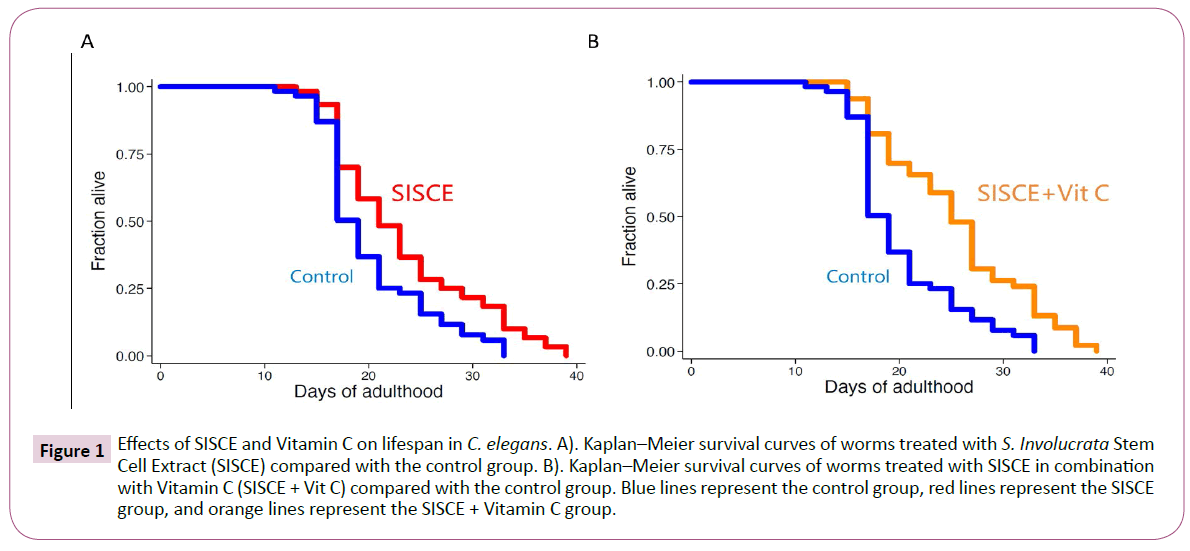
Figure 1: Effects of SISCE and Vitamin C on lifespan in C. elegans. A). Kaplan–Meier survival curves of worms treated with S. Involucrata Stem Cell Extract (SISCE) compared with the control group. B). Kaplan–Meier survival curves of worms treated with SISCE in combination with Vitamin C (SISCE + Vit C) compared with the control group. Blue lines represent the control group, red lines represent the SISCE group, and orange lines represent the SISCE + Vitamin C group.
SISCE and vitamin C improve mobility and delay age-related functional decline in C. elegans
In addition to lifespan extension, mobility assays were performed to evaluate age-related functional decline. As shown in Figure 2, mobility gradually decreased with age in all groups; however, both SISCE and SISCE + Vitamin C treatments significantly attenuated this decline compared to the control group. At early time points (Day 1–3), no significant differences in mobility were observed among groups. From Day 5 onward, worms treated with SISCE exhibited significantly higher mobility than the control group. The SISCE + Vitamin C group showed a more pronounced improvement, with significantly higher mobility observed from Day 5 through Day 11. At later stages (Day 7–11), both treatment groups maintained a higher relative mobility compared to the control group, with the SISCE + Vitamin C group consistently showing the highest mobility levels across all time points. These results indicate that treatment delayed the decline in locomotor activity during aging. Consistent with these observations, quantitative analysis demonstrated that the median number of mobility days increased from 5.1 days in the control group to 6.1 days in the SISCE group and further to 8.5 days in the SISCE + Vitamin C group (Table 2). The mobility extension rate was 20% in the SISCE group and 66% in the SISCE + Vitamin C group. Furthermore, analysis of decline slope revealed a slower rate of mobility reduction in treated groups. The decline slope improved from −0.0898 (control) to −0.0729 (SISCE) and −0.0637 (SISCE + Vitamin C), indicating a reduced rate of functional deterioration over time.
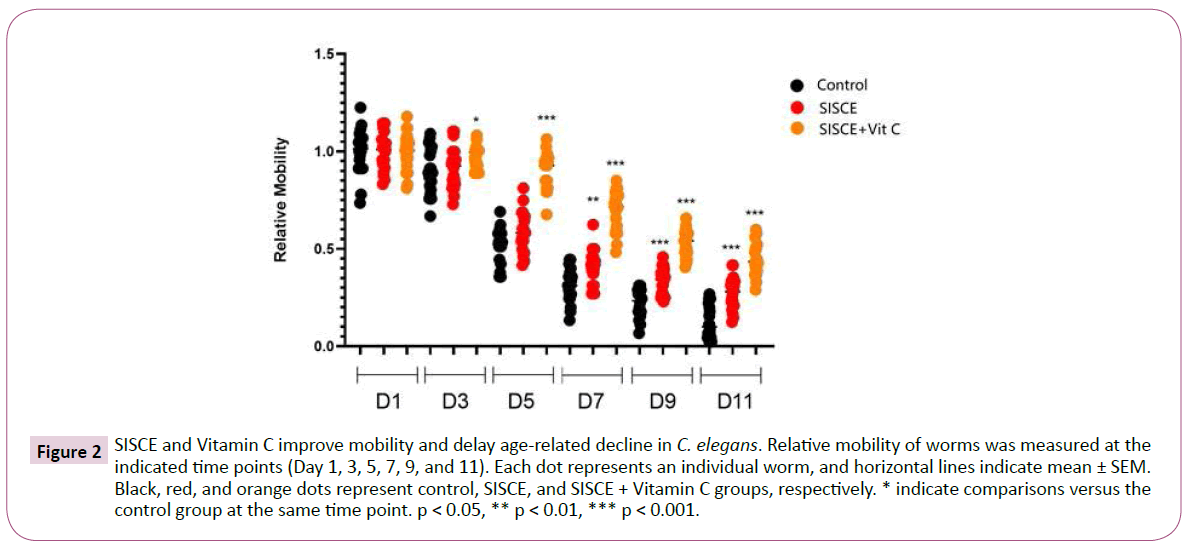
Figure 2: SISCE and Vitamin C improve mobility and delay age-related decline in C. elegans. Relative mobility of worms was measured at the indicated time points (Day 1, 3, 5, 7, 9, and 11). Each dot represents an individual worm, and horizontal lines indicate mean ± SEM. Black, red, and orange dots represent control, SISCE, and SISCE + Vitamin C groups, respectively. * indicate comparisons versus the control group at the same time point. p < 0.05, ** p < 0.01, *** p < 0.001.
| Group | Median number of mobility days | Mobility extension rate | Decline slope (Ratio/Day) |
|---|---|---|---|
| Control | 5.1 | - | -0.0898 |
| SISCE | 6.1 | 20% | -0.0729 |
| SISCE+Vit C | 8.5 | 66% | -0.0637 |
Table 2: Impact of SISCE and Vitamin C on mobility in C. elegans
Discussion
In the present study, treatment with S. Involucrata Stem Cell Extract (SISCE) significantly extended the lifespan of C. elegans and this effect was further enhanced when combined with Vitamin C. Specifically, SISCE increased the mean lifespan from 20.16 to 23.38 days (+16.0%), while the combination of SISCE and Vitamin C extended lifespan to 24.41 days (+21.1%) compared to the control group. In parallel, both treatments improved locomotor activity and delayed age-related functional decline, with the combination group showing the most pronounced effect, including a 66% increase in mobility duration and a reduced decline slope. These findings indicate that SISCE exerts anti-aging effects at both lifespan and healthspan levels and that Vitamin C provides a synergistic enhancement.
The anti-aging effects of SISCE are likely attributed to its rich composition of bioactive compounds, particularly polyphenols and flavonoids [15]. These compounds are well known for their potent antioxidant and anti-inflammatory properties, which play critical roles in modulating key aging-associated pathways [16]. Polyphenols can reduce intracellular Reactive Oxygen Species (ROS) levels, thereby alleviating oxidative damage to proteins, lipids and DNA [17]. In addition, flavonoids have been reported to suppress pro-inflammatory signaling pathways such as NF-κB, while activating cytoprotective mechanisms, including the upregulation of antioxidant enzymes [18]. In C. elegans, these effects are commonly associated with conserved longevity pathways, including the DAF-16/FOXO, SKN-1/Nrf2 and HSF-1 signaling axes, which collectively regulate stress resistance, detoxification and protein homeostasis [19]. The enhanced effects observed in the SISCE + Vitamin C group suggest a synergistic mechanism involving both antioxidant and epigenetic regulation. Vitamin C not only functions as a direct ROS scavenger but also acts as a cofactor for Ten-Eleven Translocation (TET) enzymes, thereby promoting DNA demethylation and regulating gene expression linked to cellular maintenance and stress resistance [20]. In the context of C. elegans, Vitamin C may further amplify the activation of DAF-16 and SKN-1 pathways, leading to increased expression of downstream genes such as sod-3, gst-4 and hsp-16.2 [21]. This combinational effect likely contributes to improved mitochondrial function, enhanced proteostasis and delayed physiological decline, ultimately resulting in both lifespan extension and sustained mobility.
Importantly, the observed lifespan extension in C. elegans can be further interpreted using the temporal scaling model of aging. Based on this framework, lifespan changes across species can be approximated through proportional scaling. In this study, the SISCE + Vitamin C group achieved a lifespan extension of approximately 21%. Assuming an average human lifespan of 80 years, this proportional increase would correspond to a theoretical extension of approximately 16.8 years [22]. While this extrapolation does not imply a direct translational outcome, it provides a meaningful biological context for interpreting the magnitude of the anti-aging effect and highlights the potential relevance of the findings for human health applications [23]. Despite these promising results, several limitations should be acknowledged. First, C. elegans is a simplified model organism and although many aging pathways are conserved, the complexity of human physiology cannot be fully recapitulated. Second, the study primarily focused on phenotypic outcomes (lifespan and mobility) without direct validation of molecular markers or gene expression changes, which limits mechanistic confirmation. Third, the bioavailability and metabolic fate of SISCE and its active compounds in higher organisms remain unclear. Future studies should incorporate mammalian models and clinical trials to validate efficacy, as well as omics-based approaches to elucidate underlying molecular mechanisms.
Conclusion
In conclusion, the combination of SISCE and Vitamin C demonstrates significant anti-aging potential by extending lifespan and improving functional health in a well-established model organism. From a translational and commercial perspective, this dual-component strategy represents a promising approach for the development of next-generation anti-aging products. Its multi-target mechanism, combining antioxidant protection with potential epigenetic regulation, aligns with current market trends favoring scientifically validated, mechanism-based functional ingredients. Therefore, SISCE, particularly when formulated with Vitamin C, holds strong potential for applications in nutraceuticals, healthy aging formulations and longevity-focused consumer products.
Acknowledgements
The authors would like to acknowledge the C. elegans Core Facility Taiwan, National Core Facility for Biopharmaceuticals, for providing technical support and experimental resources for this study.
References
- Tenchov R, Sasso JM, Wang X, Zhou QA (2023). Aging hallmarks and progression and age-related diseases: A landscape view of research advancement. ACS Chem Neurosci 15:1–30.
- Wei P, Zhang X, Yan C, Sun S, Chen Z, et al. (2025) Mitochondrial dysfunction and aging: Multidimensional mechanisms and therapeutic strategies. Biogerontology 26:142.
- Alberts A, Moldoveanu ET, Niculescu AG, Grumezescu AM (2025) Vitamin C: A comprehensive review of its role in health, disease prevention, and therapeutic potential. Molecules 30:748.
- Chik WI, Zhu L, Fan LL, Yi T, Zhu GY, et al. (2015) Saussurea involucrata: A review of the botany, phytochemistry and ethnopharmacology of a rare traditional herbal medicine. J Ethnopharmacol 172:44–60.
- Gong G, Huang J, Yang Y, Qi B, Han G, et al. (2020) Saussureae involucratae herba (snow lotus): Review of chemical compositions and pharmacological properties. Front Pharmacol 10:1549.
- Kang H, Kim B (2023) Bioactive compounds as inhibitors of inflammation, oxidative stress and metabolic dysfunctions via regulation of cellular redox balance and histone acetylation state. Foods 12:925.
- Neves J, Sousa-Victor P, Jasper H (2017) Rejuvenating strategies for stem cell-based therapies in aging. Cell Stem Cell 20:161–175.
- Mirotsou M, Jayawardena TM, Schmeckpeper J, Gnecchi M, Dzau VJ (2011) Paracrine mechanisms of stem cell reparative and regenerative actions in the heart. J Mol Cell Cardiol 50:280–289.
- Aggarwal S, Sardana C, Ozturk M, Sarwat M (2020) Plant stem cells and their applications: Special emphasis on their marketed products. 3 Biotech 10:291.
- Cimmino L, Neel BG, Aifantis I (2018) Vitamin C in stem cell reprogramming and cancer. Trends Cell Biol 28:698–708.
- Shenoy N, Bhagat T, Nieves E, Stenson M, Lawson J, et al. (2017) Upregulation of TET activity with ascorbic acid induces epigenetic modulation of lymphoma cells. Blood Cancer J 7:e587.
- Boyera N, Galey I, Bernard BA (1998) Effect of vitamin C and its derivatives on collagen synthesis and cross-linking by normal human fibroblasts. Int J Cosmet Sci 20:151–158.
- Gruber J, Ng LF, Poovathingal SK, Halliwell B (2009) Deceptively simple but simply deceptive–Caenorhabditis elegans lifespan studies: Considerations for aging and antioxidant effects. FEBS Lett 583:3377–3387.
- Mack HI, Heimbucher T, Murphy CT (2018) The nematode Caenorhabditis elegans as a model for aging research. Drug Discov Today Dis Models 27:3–13.
- Gao J, Wang Y, Lyu B, Chen J, Chen G (2021) Component identification of phenolic acids in cell suspension cultures of Saussurea involucrata and its mechanism of anti-hepatoma revealed by TMT quantitative proteomics. Foods 10:2466.
- Zahra M, Abrahamse H, George BP (2024) Flavonoids: Antioxidant powerhouses and their role in nanomedicine. Antioxidants 13:922.
- Rudrapal M, Khairnar SJ, Khan J, Dukhyil AB, Ansari MA, et al. (2022) Dietary polyphenols and their role in oxidative stress-induced human diseases: Insights into protective effects, antioxidant potentials and mechanism(s) of action. Front Pharmacol 13:806470.
- Khanna S, Kumar S, Sharma P, Daksh R, Nandakumar K, et al. (2025) Flavonoids regulating NLRP3 inflammasome: A promising approach in alleviating diabetic peripheral neuropathy. Inflammopharmacol 33:2231–2262.
- Jia W, Wang C, Zheng J, Li Y, Yang C, et al. (2022) Pioglitazone hydrochloride extends the lifespan of Caenorhabditis elegans by activating DAF-16/FOXO- and SKN-1/NRF2-related signaling pathways. Oxid Med Cell Longev 2022:8496063.
- Young JI, Zuchner S, Wang G (2015) Regulation of the epigenome by vitamin C. Annu Rev Nutr 35:545–564.
- Zeng WY, Tan L, Han C, Zheng ZY, Wu GS, et al. (2021) Trigonelline extends the lifespan of Caenorhabditis elegans and delays the progression of age-related diseases by activating AMPK, DAF-16, and HSF-1. Oxid Med Cell Longev 2021:7656834.
- Stroustrup N, Anthony WE, Nash ZM, Gowda V, Gomez A, et al. (2016) The temporal scaling of Caenorhabditis elegans ageing. Nature 530:103–107.
- Furrer R, Handschin C (2025) Biomarkers of aging: From molecules and surrogates to physiology and function. Physiol Rev.
Google Scholar, Cross Ref, Indexed at
Google Scholar, Cross Ref, Indexed at
Google Scholar, Cross Ref, Indexed at
Google Scholar, Cross Ref, Indexed at
Google Scholar, Cross Ref, Indexed at
Google Scholar, Cross Ref, Indexed at
Google Scholar, Cross Ref, Indexed at
Google Scholar, Cross Ref, Indexed at
Google Scholar, Cross Ref, Indexed at
Google Scholar, Cross Ref, Indexed at
Google Scholar, Cross Ref, Indexed at
Google Scholar, Cross Ref, Indexed at
Google Scholar, Cross Ref, Indexed at
Google Scholar, Cross Ref, Indexed at
Google Scholar, Cross Ref, Indexed at
Google Scholar, Cross Ref, Indexed at
Google Scholar, Cross Ref, Indexed at
Google Scholar, Cross Ref, Indexed at
Google Scholar, Cross Ref, Indexed at
Google Scholar, Cross Ref, Indexed at
Google Scholar, Cross Ref, Indexed at
Open Access Journals
- Aquaculture & Veterinary Science
- Chemistry & Chemical Sciences
- Clinical Sciences
- Engineering
- General Science
- Genetics & Molecular Biology
- Health Care & Nursing
- Immunology & Microbiology
- Materials Science
- Mathematics & Physics
- Medical Sciences
- Neurology & Psychiatry
- Oncology & Cancer Science
- Pharmaceutical Sciences