


 10 / 16

Page 22
Volume 05
Journal of Infectious Diseases and Treatment
ISSN: 2472-1093
JOINT EVENT
Applied Microbiology-2019 & Antibiotics 2019
Immunology 2019
October 21-22, 2019
October 21-22, 2019 Rome, Italy
&
&
8
th
Edition of International Conference on
Antibiotics, Antimicrobials & Resistance
12
th
International Conference on
Allergy & Immunology
6
th
World Congress and Expo on
Applied Microbiology
Lysogens in the natural microbial communities of the warm Red Sea
Ruba Abdulrahman Ashy, Curtis Suttle
and
Susana Agusti
King Abdullah University of Science and Technology, Saudi Arabia
V
iruses are the most abundant microorganisms in marine environments. Viral infections can be either lytic
(virulent) or lysogenic (temperate phage) within the host cell. The Red Sea is a narrow oligotrophic basin
classified as the warmest water temperatures, which may affect the dynamics of microbial community. Studies on
lysogenic bacteria in the Red Sea remain unexplored. The aim of this study was to quantify viral dynamics in the
Red Sea and to investigate the occurrence of lysogenic bacteria based on a temporal study. Over two years, we
quantified fortnightly environmental parameters and virus and bacterial abundances in a coastal station of the Red
Sea. During the second year, monthly seawater samples were examined for prophage induction by mitomycin C.
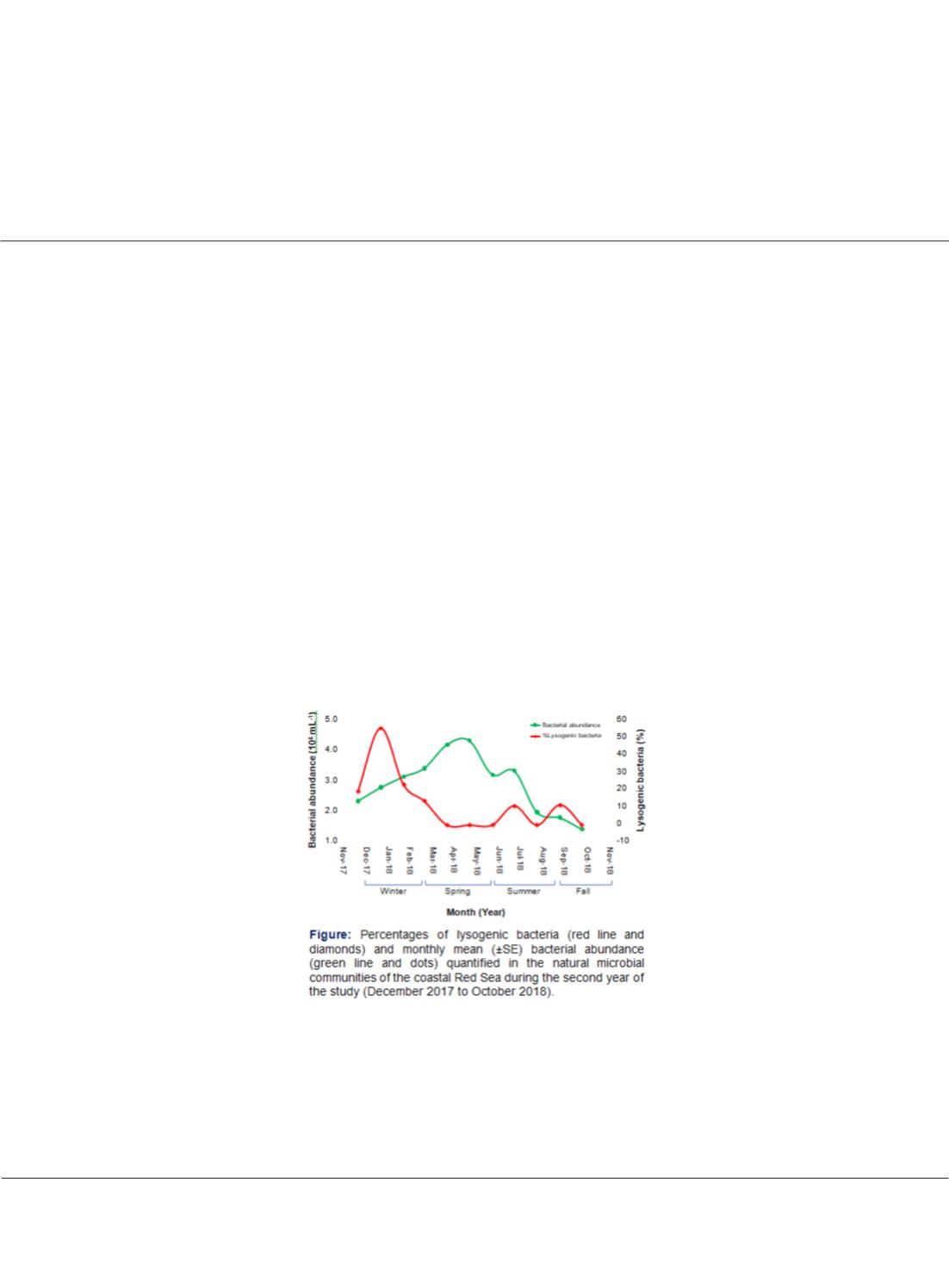
Water temperatures were high, from 25.4 to 31.93 °C and total viral and bacterial abundances ranged from 1.51 to
8.56 × 10⁶ and from 1.94 to 3.16 x 10⁵ cells mL-1, respectively. The burst size was calculated as 13.81. We determined
that 12.24 % ±4.82 (SE) of the treated bacteria were lysogenized with the highest percentage of 55.8% observed in
January 2018 when bacterial abundances were low. Second small proportions were identified in July and September,
which potentially related to the stressful conditions to phages with no induction, was observed in the spring time
where bacterial abundances were at the highest. Our results confirm that lysogenized cells were favoured when
bacterial populations were low; however, there was no clear relationship between lysogeny and seasonal changes in
the Red Sea environmental conditions, as the stressful summer did not induce high lysogeny neither lytic infection.
Biography
Ruba Abdulrahman Ashy is pursuing her PhD in Environmental Science and Engineering Department, Red Sea Research Center at King Abdullah University
of Science and Technology, Thuwal, Saudi Arabia. She worked as a teacher assistant of Microbiology Science from 2009 at King Abdulaziz University, SA. Her
PhD research interest is in environmental microbiology and virology. Her main aim focuses on determining the potential viability of lysogenic bacteria or infectious
viruses and their survival in certain environmental areas by the development and the evaluation of virus detection methods. This research will explore the factors
behind the spread of viral infections in different environmental areas including the Red Sea.
Ruba Abdulrahman Ashy et al., J Infec Dis Treat 2019, Volume: 05