ISSN : 2249 - 7412
Asian Journal of Plant Science & Research
Apamarga (Achyranthes aspera) a Lord of All Plants
Shinde Tejashri Sunil*
Department of Pharmacy, SSR College of Pharmacy, Silvassa, Dadra and Nagar Haveli and Daman and Diu, India
- *Corresponding Author:
- Shinde Tejashri Sunil
Department of Pharmacy, SSR College of Pharmacy, Silvassa, Dadra and Nagar Haveli and Daman and Diu, India
E-mail:
Received date: December 12, 2023, Manuscript No. AJPSKY-24-18199; Editor assigned date: December 16, 2023, PreQC No. AJPSKY-24-18199 (PQ); Reviewed date: December 31, 2023, QC No. AJPSKY-24-18199; Revised date: February 03, 2025, Manuscript No. AJPSKY-24-18199(R); Published date: February 10, 2025, DOI: 10.36648/2249-7412.15.1.316
Citation: Sunil ST (2025) Apamarga (Achyranthes aspera) a Lord of All Plants. Asian J Plant Sci Vol:15 No.1:316
Abstract
Achyranthes aspera commonly known as Apamarga is herbal medicinal plant distributed throughout India and is used traditionally in wound healing, piles, skin diseases and dental problems. Different constituents are present in different parts of Achyranthes aspera like saponin, oleanic acid, achyranthine, ecdysterone, alkaloids, flavonoids, steroids and terpenoids. The review reveals that a large number of phytochemical constituents have been isolated from the plant which possesses several ethnobotanical uses as well as pharmacological activities like antibacterial, antifungal, antipyretic, diuretic, purgative, laxative, antiasthmatic, hepatoprotective and anti-allergic
Keywords
Antiasthmatic; Apamarga; Pharmacological activities; Traditional medicine; Ayurveda.
Introduction
Achyranthes aspera: Common name Chaff-flower, prickly chaff flower, devil horsewhip, Sanskrit known as Apamarga. It is sepsis of plant Achyranthes aspera belonging to family Amaranthaceae. It is circulated throughout the tropical world. It can be found in many places rising as a presented cad species and common weed it is aggressive species in some areas, including many pacific Island environment [1].
Ayurveda is the one of the ancient and comprehensive systems of health care. An analysis of Ayurvedic treaties signifies that various aspects of Ayurveda were involved from time to time. It has got number of medicinal uses and is beneficial to us (Figure 1) [2].
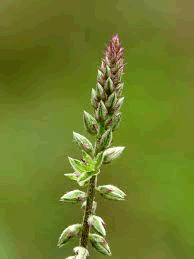
Figure 1: Achyranthes aspera.
Materials and Methods
Apamarga in Veda
Rigveda: In Rigveda while describing medicinal plants, origin of medicinal plant dated back three Yuga prior to life became existence on earth. This shows the benefits of medicinal plants. In Rigveda no reference of Apamarga noticed [3].
Yajurveda: In different Samhitas of Yajurveda, Saktu i.e., the powder of Apamarga used in Hawan for the aim of Rakshoghnaproperty. It should be used after removing the water content from it. This represents that it should be used after drying or no other plant has got such property of removing water content from our body. It has got property like Papanashan, Mritunashanaand Duhswapnanasana. Kushthais known to be paaproga. This indicates towards the Kushthaghnaproperty of Apamarga. Duhswapnanashana indicates its Metaproperty [4].
Samaveda: In Saamvedano reference of Apamargawas noticed.
Atharvaveda: Atharvaveda is the fourth and last Veda of Hindu literature. Its oldest name was ‘Atharvangirasa’, because it was contributed by two sages, ATHARVAN and ANGIRA. It is also known as ‘Bhaisajyaveda’. The Ayurveda is said to be the Unpaved of Atharvaveda, whereas according to Acharya Kashyap Ayurveda is considered as fifth Veda. Atharvaveda broadly quoted Apamarga according to the etymology provided by Sayana, this plant drives away the vitiated Doshas from the body. Paippalada school of Atharvaveda describes it as Dourbhagyanasanaand Anapatyanasana. This indicates towards is Kushthaghna property. Apamargais considered as lord of all plants because it possesses hundreds of properties and wipe away all the diseases. Apamargais used to treat diseases caused by thirst, hunger, sterility etc. Apamargawipe away diseases like Kshetriya rogaand prevent Yatudhan Krimi. Sayanaand the native tradition considers it to be an anomalous word signifying a disease beginning with consumption, skin disease and epilepsy, derived from the limbs of father or mother, curable in the body of grandson or son. Apamargawipe away the diseases which occur due to sitting together with person having black teeth, diseased nails, or one who is deformed. This mantra indicates towards the Sansargaja Kushtha [5,6].
Taxonomic classification
Kingdom: Plantae
Subkingdom: Tracheobinota super
Division: Spermatophyta
Division: Magnoliophyte
Class: Mangoliophsida
Subclass: Caryophyllidae
Order: Caryophyllales
Family: Amaranthaceae
Genus: Achyranthes
Species: Aspera vernacular
Vernacular name
Arabic Atkumah
Bengali Apang
Burmese Kune-la-mon
English Rough chaff /Prickly chaff – flower, devil’s horsewhip
Gujarati Aghedo
Hindi Latjira, Aghara, Apamarga, Chirchira, Chirchit
Kannada Uttatane
Konkan Uttatene
Malayalam Katalati/Kadaladi
Marathi Aghadha/Pandhara–agada
Persian Khare–Vazhun
Punjabi Kutri
Tamil Nayurivi/Shiru-kadaladi
Telugu Uttareni/Antisha/Apamargamu
Sanskrit Apamarga/Aghata/Kharamanjari
Sinhala Karala heba
Urdu Chirchita
Results
Pharmacological activities
Hepatoprotective activity: Bafna and Mishra reported that the methanol extract of the aerial parts of A. aspera shown hepatoprotective activity on rifampicin induced hepatotoxicity in albino rats [7,8]. Methanol extract also showed dose dependent decrease in the levels of SGPT, SGOT, ALKP and total bilirubin [9-11].
Antiviral activity: Chakraborty et al., reported the in vitro assay of the methanol leaves extract of A. aspera (100 μg) which revealed significant inhibitory effects on the Epstein-Barr virus early antigen induced by the tumor promoter 12-Otetradecanoylphorbol-13-acetate in Raji cells. The fraction containing mainly non-polar compounds showed the most significant inhibitory activity (96.9% and 60% viability). In the in vivo two stage mouse skin carcinogenesis test the total methanol extract reported a pronounced anticarcinogenic effect. The total extract and the fraction are believed to be valuable anti-tumors promoters in carcinogenesis [12].
Anti-inflammatory activity: The alcohol extracts of leaves and seeds of A. aspera shown anti-inflammatory activity in rats using carrageenin-induced paw edema method and formalin model. Ethanol extract of A. aspera at the doses of 50, 100, and 200 mg/kg were screened for their effect on acute and chronic inflammation induced in mice and rats using carrageenin and freund’s complete adjvant model. Anti-arthritic activity Neogi et al., the water-soluble alkaloid achyranthine was screened for its anti-inflammatory and antiarthritic activity against carragennin induced foot odema, granuloma pouch, formalin induced arthritis and adjuvant arthritis in rats [13].
Spermicidal activity: Ethanol extract of root of A. aspera showed post coital antifertility activity in female albino. Root extract of A. aspera shown spermicidal activity in human and rat sperms. Pakrashi and Bhattacharya reported that the benzene extract of the whole plant of A. aspera shown abortifacient activity in mice. Shibeshi, et al. also reported the spermicidal effects of methanolic extract of the leaves [14].
Anti-fertility activity: Prakashi and Bhattacharya reported that the benzene crude extract has abortifacient effect in mice. The alcoholic extract of root bark of A. aspera inhibit the response of oxytocin in isolated rat uterus but this fraction did not inhibit the responses to serotonin and acetylcholine in the rat uterus [15] .
Discussion
Antioxidant activity: Antioxidant activity of A. aspera crude root extract was evaluated in a series of in vitro assay 1,1-diphenyl-2-picrylhydrazyl (DPPH) and Hydroxyl Radical Scavenging method were determined. Antidiabetic and Hypoglycemic activity Aqueous and methanol extracts of the powdered whole plant of A. aspera, showed hypoglycemic activity. Blood glucose levels of normal and Alloxan induced diabetic rabbits were determined after oral administration of various doses. The ethanol extract of A. aspera seed exhibited significant hypoglycemic activity in streptozotocin induced diabetic rats. Akhtar, et al., reported the aqueous and methanol extracts of the powdered whole plant of A. aspera shown hypoglycemic activity. Blood glucose levels of normal and Alloxan induced diabetic rabbits were determined after oral administration of various doses [16].
Larvicidal activity: Ethanol crude extract of A. aspera showed high larvicidal activity on the tick larvae against Boophilis microplus. Larvicidal saponins from leaf extracts of A. aspera have been tested against Aedes aegypti and Culex quinquefasciatus. Ethyl acetate leaf extract was found to be active against Aedes subpictus mosquito larvae. A. aspera was mentioned to have activity in controlling mosquito larvae. Essential oils of leaf and stem extracted by steam distillation were found to possess larvicidal activity against Aedes aegypti and Culex quinquefasciatus. Leaf extracts of the A. aspera have been reported to be active against Aedes aegypti [17].
Anti-dandruff activity: Suresh et al., reported that the methanol leaf extract of A. aspera as a constituent of a Polyherbal Hair Oil (PHO) showed anti-dandruff activity. Neuropharmacological activity methanol extract of the A. aspera was reported to have neuropharmacological activity. It possesses antidepressant 50 and anxiolytic 51 activities. The plant was screened in vitro for anti-hypertensive effect. Renal disorders mineralization of urinary stones like calcium oxalate, calcium carbonate and calcium phosphate were found to be inhibited by A. aspera. Methanol extracts were found to prevent lead induced nephrotoxicity in albino rats. Efficacy of the roots of the plant was tested on calcium oxalate crystal nucleation and growth in vitro and on oxalate induced injury in NRK-52E (rat renal tubular epithelial) cells [18].
Antiobesity activity: Mangal et al., reported that the plant was clinically investigated against obesity and showed positive result. Veterinary uses A. aspera was reported to have diuretic activity in goats and diarrhea preventive activity in piglets. Therapeutic efficacy of herbal preparation involving the plant in induced hepatopathy in sheep was tested [19].
Prothyroidic activity: Tahilani et al., reported leaves extracts of A. aspera to have prothyroidic and antiperoxidative properties. In rats, the plant extract induced changes in thyroid hormone concentration and decrease hepatic lipid peroxidation [20].
Conclusion
Therapeautic and traditional uses
• Apamarga root is taken with water in Visuchika.
• In Sidhma, seeds of Mulaka and fresh juice of Apamarga are made to paste and applied externally.
• Decoction of Kakjangha, Apamarga, Kokilaksa, and Suparnika is useful in Nidranasa (insomnia).
• The root of Apamarga and Piper nigrum is used in snake poison.
• The decoction of Apamargaa, Yastimadhu, Gokshura, and Patha is used for urinary tract infections.
• Apamarga kshara is used in chronic cough disease with Pippali, Ativisha, Kupilu, Ghrit, and Madhu.
• Apamarga root is made as a paste with Tanduloodak and used with honey in Arsha. The paste of seed of Apamarga is used for Raktrasha externally. • In Ashmari, Apamarga kshara is used with sheep milk.
• The juice of Apamarga is painted on gums in toothache.
• Apamarga is one of the essential plants in the management of Kaphaja Timira as fumigation.
• Apamarga seeds powder as an avapidanasya helps cure Apachi (cervical Lymphadenopathy).
• The collyrium prepared with Flowers of Apamarga is useful in Praklinnavartma (eyelid disease).
• Decoction of powdered leaves with honey or sugar candy is useful in the early stages of diarrhea and dysentery.
• Crushed plant is boiled in water and is used for pneumonia. Infusion of the root is a mild astringent in bowel complaints. The flowering spikes or seeds, ground and made into a paste with water, are used as an external application for bites of poisonous snakes and reptiles, used in night blindness and cutaneous diseases.
References
- List BS (2007) Botanical society of Britain and Ireland.
- Handa N (2000) Wild flowers of India. Books Today.
- Ramgopal Sastry PR (2003) Vedon men Ayurveda Vaidya. Parimal Publication, Delhi, India. 201.
- Bafna AR, Mishra SH (2004) Effect of methanol extract of Achyranthes aspera Linn. on rifampicin-induced hepatotoxicity in rats. Ars Pharmaceutica 45:343-451.
- Chakraborty A, Brantner A, Mukainaka T, Nobukuni Y, Kuchide M, et al. (2002) Cancer chemopreventive activity of Achyranthes aspera leaves on Epstein–Barr virus activation and two-stage mouse skin carcinogenesis. Cancer Lett 177:1-5.
[Crossref] [Google Scholar] [PubMed]
- Gokhale AB, Damre AS, Kulkarni KR, Saraf MN (2002) Preliminary evaluation of anti-inflammatory and anti-arthritic activity of S. lappa, A. speciosa and A. aspera. Phytomedicine 9:433-437.
[Crossref] [Google Scholar] [PubMed]
- Neogi NC, Rathor RS, Shrestha AD, Banerjee DK (1969) Studies on the anti-inflammatory and anti-arthritic activity of ach. yranthine. Indian J Pharmacol 1:37-48.
[Google Scholar] [PubMed]
- Vasudeva N, Sharma SK (2006) Post-coital antifertility activity of Achyranthes aspera Linn. root. J Ethnopharmacol 107:179-181.
[Crossref] [Google Scholar] [PubMed]
- Pakrashi A, Bhattacharya N (1977) Abortifacient principle of Achyranthes aspera Linn. Indian J Exp Biol 15:856-858.
[Google Scholar] [PubMed]
- Anand M, Selvaraj V, Alagar M (2014) Phytochemical screening and evaluation of (in vitro) antioxidant activity of Achyranthes aspera root extract. Int J Phar Pharma 6:192-197.
- Akhtar MS, Iqbal J (1991) Evaluation of the hypoglycaemic effect of Achyranthes aspera in normal and alloxan-diabetic rabbits. J Ethnopharmacol 31:49-57.
[Crossref] [Google Scholar] [PubMed]
- Vijayaraj R, Vidhya R (2016) Biological activity of Achyranthes aspera Linn.—a review. AJBPR 1:86-93.
- Kamalakannan S, Murugan K, Barnard DR (2011) Toxicity of Acalypha indica (Euphorbiaceae) and Achyranthes aspera (Amaranthaceae) leaf extracts to Aedes aegypti (Diptera: Culicidae). J Asia Pac Entomol 14:41-45.
- Barua CC, Begum SA, Talukdar A, Pathak DC, Barua AG, et al. (2010) Effect of Achyranthes aspera Linn on modified forced swimming in rats. Pharmacologyonline 1:183-191.
- Hansen K, Nyman U, Smitt UW, Adsersen A, Gudiksen L, et al. (1995) In vitro screening of traditional medicines for anti-hypertensive effect based on inhibition of the Angiotensin Converting Enzyme (ACE). J Ethnopharmacol 48:43-51.
[Crossref] [Google Scholar] [PubMed]
- Jahan N, Ahmad R, Hussain F (2002) Evaluation of diuretic activity of Achyranthes aspera (Chirchira) in goats. Pak Vet J 22:124-127.
- Tahiliani P, Kar A (2000) Achyranthes aspera elevates thyroid hormone levels and decreases hepatic lipid peroxidation in male rats. J Ethnopharmacol 71:527-532.
[Crossref] [Google Scholar] [PubMed]
- Zysk KG (1996) Medicine in the Veda. Motilal Banarasidass Publishers Private Limited, New Delhi, India. pp. 20.
- Bloomfield M (1897) Hymns of the Atharvaveda. Clarendon Press, Oxford, England. 72.
- Sharma AK (2013) Medicinal Properties of Apamarg (Achyranthes aspera Linn.). Int J Ayurveda Pharma Res 1:4-12.

Open Access Journals
- Aquaculture & Veterinary Science
- Chemistry & Chemical Sciences
- Clinical Sciences
- Engineering
- General Science
- Genetics & Molecular Biology
- Health Care & Nursing
- Immunology & Microbiology
- Materials Science
- Mathematics & Physics
- Medical Sciences
- Neurology & Psychiatry
- Oncology & Cancer Science
- Pharmaceutical Sciences