


 5 / 32

Polymer Congress 2018
Polymer Sciences
ISSN: 2471-9935
Page 59
June 04-05, 2018
London, UK
4
th
Edition of International Conference on
Polymer Science and
Technology
Monika Paúrová et al., Polym Sci 2018, Volume 4
DOI: 10.4172/2471-9935-C2-012
Synthesis and characterization of polypyrrole nanoparticles
Monika Paúrová
and
Michal Babič
IMC - CAS, Czech Republic
C
onducting polymers with extended -conjugated structures
have received great attention as multifunctional materials
due to their wide range of potential applications in various
technological and biological areas such as polymeric
rechargeable batteries, corrosion protection, coating
layers, electrochromic displays, chemical and biological
sensors, functional membranes, drug delivery systems
and contrast agents. Among conducting polymers/organic
polymer based nanoparticles, polypyrrole (PPy)/polypyrrole
nano- and microparticles (PPy-NPs) have attracted a great
interest owing to their high conductivity, relatively high
stability in different chemical conditions, inert character for
biological systems, biocompatible behavior and simplicity of
preparation. Development of methods for controlling the size
and surface properties of PPy-NPs has been made. PPy-NPs
were synthesized via water based redox nanoprecipitation
polymerization initiated by an oxidant in the presence of
surfactantsorsolublepolymerstabilizers.Toensuretherequired
size of synthetizing particles and good stability of colloidal
dispersion, the reaction mixtures were controlled by the various
concentration of organic stabilizers (e.g. polyvinylpyrrolidone
(Mw=40000), poly(ethylene glycol) (Mn=4000), sodium
dodecyl sulfate, docusate sodium) and specific type of
oxidizing agents (e.g. H
2
O
2
, (NH
4
)2S
2
O
8
, FeCl
3
•6H
2
O, MnO
2
).
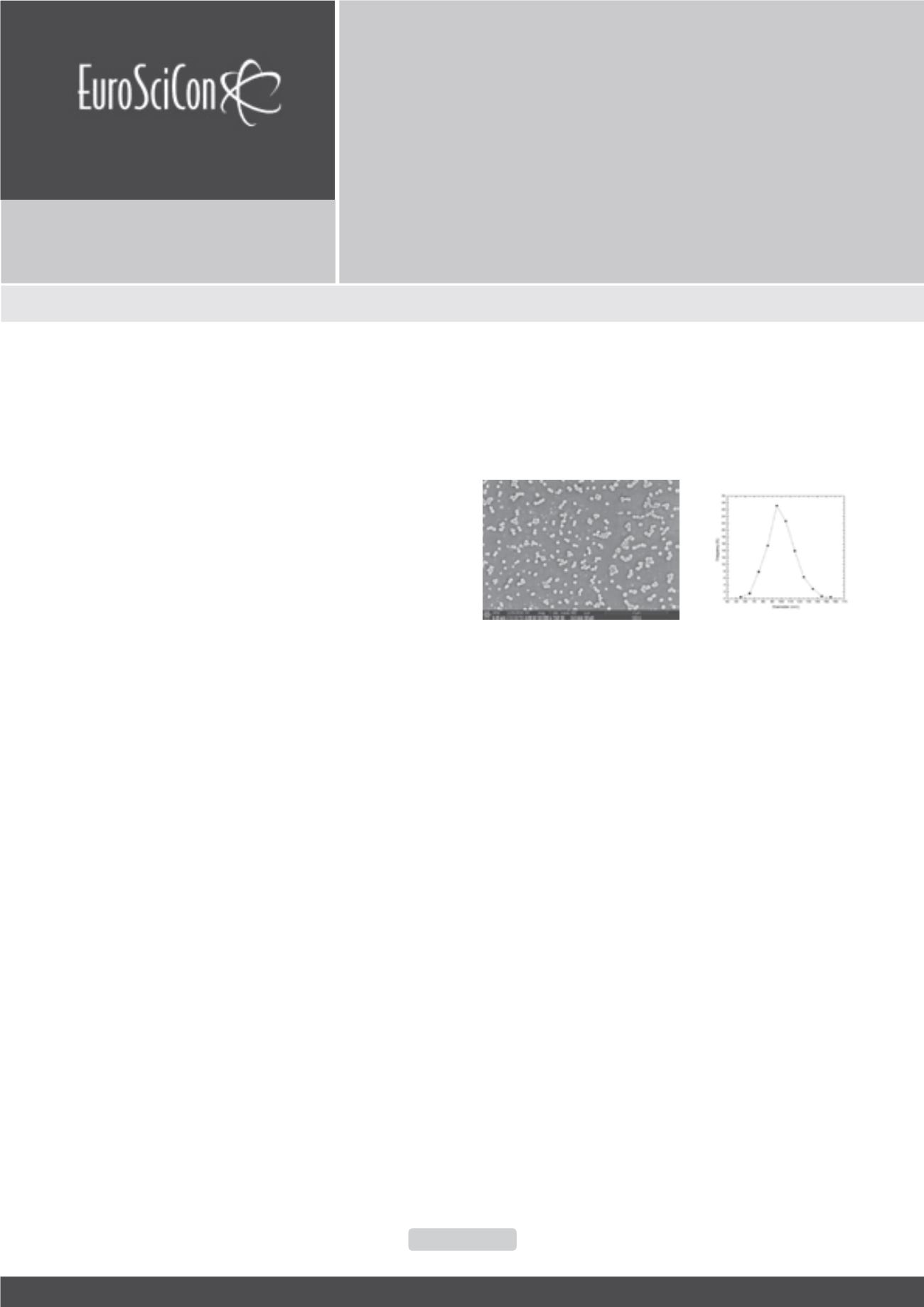
Morphological studies of prepared materials were investigated
by using transmission and scanning electron microscope (TEM
and SEM, Figure 1). Hydrodynamic properties, size distribution
and zeta potential of the studied particles were measured and
determined by dynamic light scattering on Zetasizer (Malvern
device). Primary photoabsorption studies were done on UV-Vis
spectrometer (Analytic Jena device) as well.
Recent Publications
1. Menshikova A Yu, Shabsels BMand EvseevaTG (2003)
Synthesis of polypyrrole nanoparticles by dispersion
polymerization. Russ. J. Appl. Chem. 76(5):822-826.
2. Pecher J and Mecking S (2010) Nanoparticles of
conjugated polymers. Chem. Rev. 110(10):6260-6279.
3. Woo H Y (2010) Synth. Met. 160:588-591.
4. Hazarika J and Kumar A (2013) Controllable synthesis
and characterization of polypyrrole nanoparticles in
sodiumdodecylsulphate (SDS) micellar solutions. Synth.
Met. 175:155-162.
5. Vaitkuviene A et al. (2013) Evaluation of cytotoxicity
of polypyrrole nanoparticles synthesized by oxidative
polymerization. J. Haz. Mat. 250-251:167-174.
Biography
Monika Paúrová obtained her PhD at Charles University, Prague, Czech
Republic. She has gained experiences in synthesis of bifunctional
ligands for selective metal binding and low-molecular functionalized
chelating compounds. She is currently investigating design, synthesis
and characterization of composite polymer based on inorganic/polymer
nano- and microparticles and their consequent surface modifications/
functionalization for bioapplication ( at the Institute of Macromolecular
Chemistry of the Academy of Science, Czech Republic).
paurova@imc.cas.czFigure 1:
SEM image of PPy-NPs obtained in the presence of PVP (M
w
=40000) and
FeCl
3
•6H
2
O (left), size distribution of PPy nanoparticles (right).