


 8 / 23

Page 33
Notes:
Volume 10
Journal of Archives of Medicine
Advanced Biotechnology & Annual Pediatrics 2018
November 28-29, 2018
Novel Trends and Advances in Biotechnology,
Cell & Stem Cell Research
15
th
Annual Congress on Pediatrics
World Congress on
&
November 28-29, 2018 Barcelona, Spain
Joint Event On
Influence of topography of porous–Nurse´s A phase bioceramic on metabolic activity of adult
human mesenchymal stem cells
Ruben Rabadan-Ros
1
, Clara Meseguer-Ortiz
2
, Belén Gil-Muñoz
3
, JI Peña
4
, Lorena Grima
4
, Luis Meseguer-Olmoand
1
and Dra Piedad N de Aza
5
1
Catholic University of Saint Anthony, Spain
2
Morales Meseguer University Hospital, Spain
3
Mesa del Castillo Hospital, Spain
4
Zaragoza University-CSIC, Spain
5
Miguel Hernández University, Spain
I
t is well known that Si-Ca-P bioceramics are promising
bioactivematerials for bone tissue engineering, particularly
for bone repair
1
. Silicon incorporation to these ceramics
may be fundamental to skeletal development stimulating
mesenchymal stem cells proliferation and differentiation to
osteoblasts
2,3
. An important characteristic of a bioceramic
designed for bone reconstruction is its open porosity with a
high area / volume ratio that facilitates the initial circulation
of biological fluids, cell migration and vascular invasion
after bone implantation
4,5
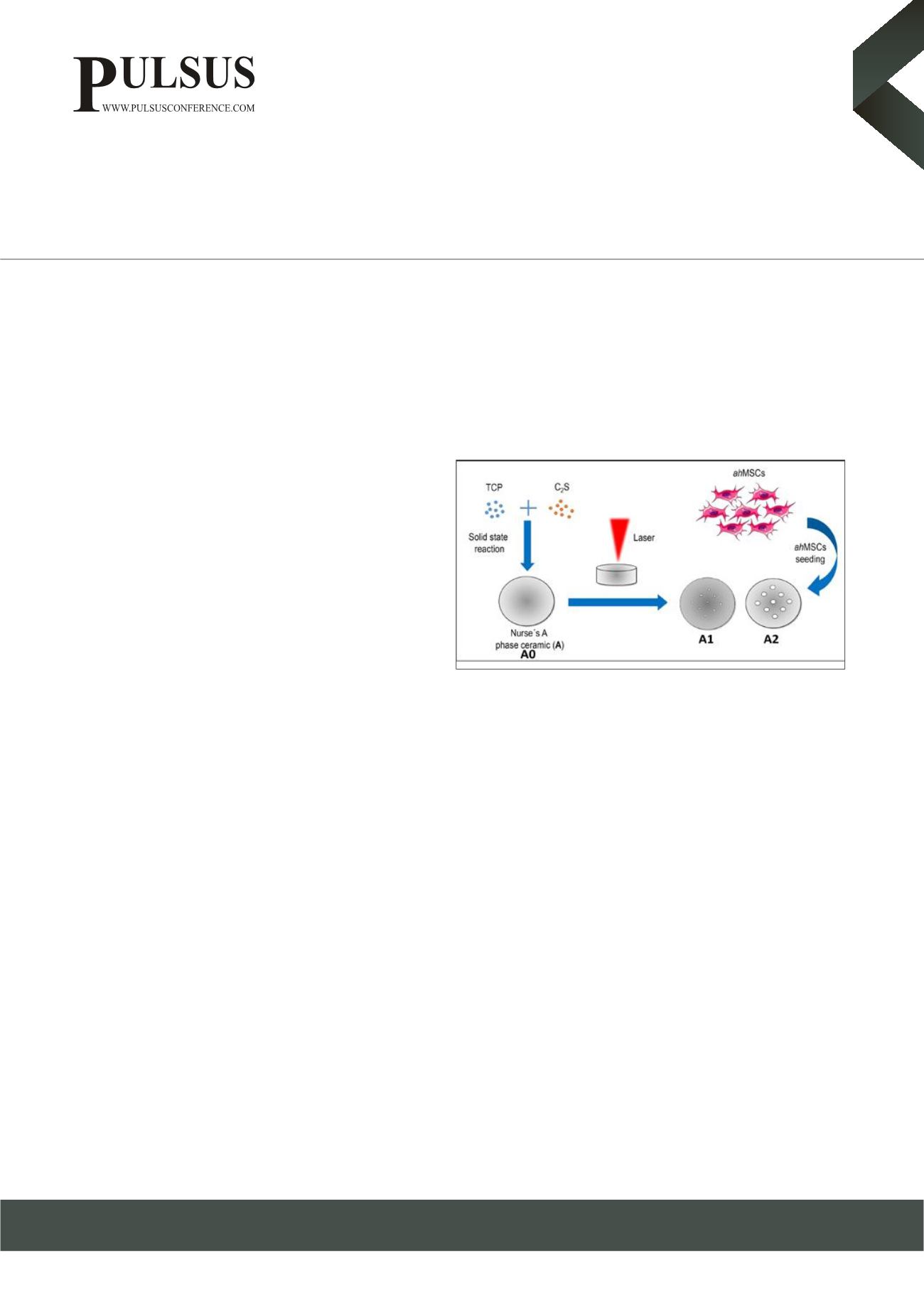
. In this work, we have processed
a Si-Ca-P ceramic using a Q-switched Nd:YAG laser,
obtaining biocompatible ceramics with 70 µm and 350 µm
homogeneously distributed interconnected pores.
In vitro
assays using
ah
MSCs showed that cells seeded onto the top
of these scaffolds could proliferate, cross the small pores and enter into big pores. So, if we use these bioceramics
in vivo
, we
could probably observe how the cells penetrate into the bioceramics through the pores, improving the cellular and vascular
colonization of the biomaterial and allowing initial circulation of the body fluids from the first moment of implantation,
increasing the bioceramic biodegradability.
Biography
Ruben Rabadan (PhD) is a post-doctoral researcher who has his expertise in Tissue Repair, and passion in improving the health by the study of Organ and Tisse
Regeneration. In his short career, he has focused in bone, ligament and cartilage regeneration, and he has helped to develop scaffolds based on the C2S-TCP
phase diagram and combinating bioceramics with fibroin, specially testing their biocompatibility and osteointegration by
in vitro
and
in vivo
studies.
rubenrabadanros@gmail.comRuben Rabadan-Ros et al., Arch Med 2018, Volume 10
DOI: 10.21767/1989-5216-C2-006
Figure: Synthesis of porous Nurse´s A phase and ahMSCs seeding