



 3 / 23

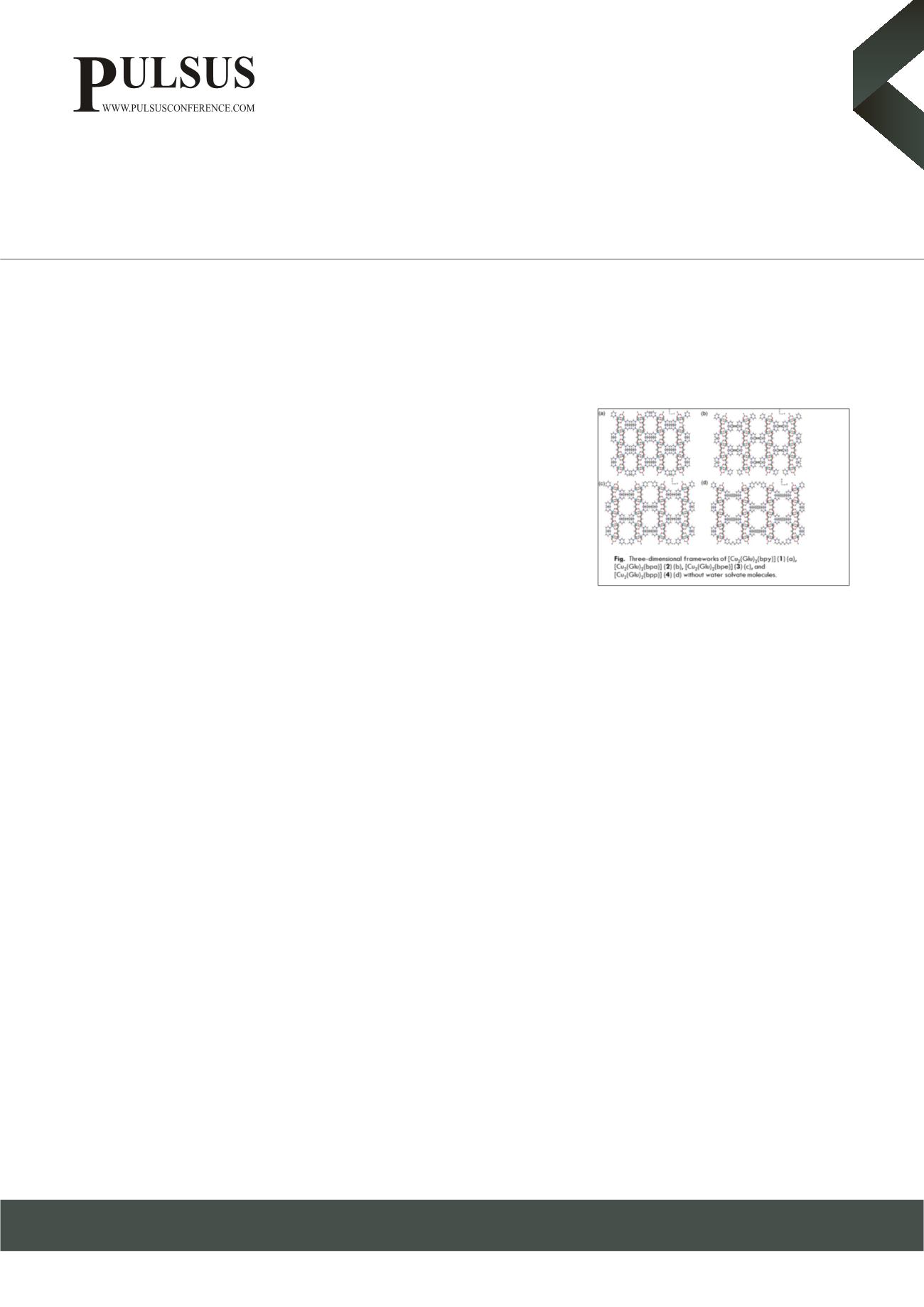
Page 27
Notes:
Volume 10
Journal of Archives of Medicine
Advanced Biotechnology & Annual Pediatrics 2018
November 28-29, 2018
Novel Trends and Advances in Biotechnology,
Cell & Stem Cell Research
15
th
Annual Congress on Pediatrics
World Congress on
&
November 28-29, 2018 Barcelona, Spain
Joint Event On
Highly bioactive porous 3D Cu-MOFs against MRSA
Do Nam Lee
1
, Hyun-Chul Kim
2
, Seong Huh
2
, Sung-Jin Kim
3
and Youngmee Kim
3
1
Kwangwoon University, South Korea
2
Hankuk University of Foreign Studies, South Korea
3
Ewha Woman’s University, South Korea
M
etal-Organic Frameworks (MOFs) are a group of highly porous crystalline
materials consisting of metal clusters interconnected with organic linkers.
Owing to their high porous and regular structure properties, MOFs has been
expanded in biology and medicine as well as gas storage, purification and catalysis.
Transition metal ions and metal nanoparticle containing Cu, Zn, Co and Ag have
gained prominence as substitutes for new antibacterial agent to effect on bacteria.
However, it is known excessive metal ions leached frommetal nanoparticle would be
harmful to the normal tissue as well as to bacteria. To solve these leakage problems,
many researchers tried to trap the metal ion in MOF through coordination of bio
active metal ion to organic ligands. New antimicrobial material composed of robust
and porous Cu-MOFs are designed in consideration of the inherent characteristics
of the metal and organic ligand such as oxidation number, counter ion, the coordination mode, the size and bridging property
of the ligand. Bioactive porous three-dimensional Cu-MOFs representing high selective gas sorption were synthesized by
hydrothermal reaction. Cu-MOFs containing Cu
2
di-nuclear units connected by flexible glutarate and bipyridyl ligands are
formulated as [Cu
2
(Glu)
2
(μ-L)]•x(H
2
O) (Glu=glutarate, L: bpy=1,2-bis(4-pyridyl) (1), bpa = 1,2-bis(4-pyridyl)ethane (2), bpe
= 1,2-bis(4-pyridyl)ethene (3), bpp = 1,2-bis(4-pyridyl)propane (4)). The single crystal X-ray study showed that Cu-MOFs
contain paddle-wheel Cu
2
di-nuclear units connected by glutarates to form two-dimensional (2D) sheets and these sheets were
bridged by bipyridyl ligand to form three-dimensional (3D) frameworks. The number of solvent water molecules in MOF was
calculated from elemental analysis and TGA. The solvent-free MOFs 1, 2, 3 and 4 indicated 18.9%, 26.5%, 27.7% and 30.8%
of void volumes, respectively, based on the PLATON analysis and contain well-defined 1D channel. Porous 3D Cu-MOF
exhibited high selective sorption of quadrupolar CO
2
over N
2
and H
2
. Antibacterial activities of Cu-MOFs against MRSA will
be discussed.
Biography
Do Nam Lee has received her BS and MS from Yonsei University in Chemistry. She has earned her PhD from Yonsei University (1992) under the supervision of
Prof. Chang Hwan Kim and completed Postdoctoral study as a member of the groups of Prof. Robert West at University of Wisconsin-Madison. She has worked
as visiting scholar at Peking University. She is currently an associate professor at Kwangwoon University, Republic of Korea and mostly focusing on researches of
synthesis and application of coordination comlpexes, functional metal organic frameworks and polymers.
donamlee@hanmail.netDo Nam Lee et al., Arch Med 2018, Volume 10
DOI: 10.21767/1989-5216-C2-006