


 7 / 23

Page 32
Notes:
Volume 10
Journal of Archives of Medicine
Advanced Biotechnology & Annual Pediatrics 2018
November 28-29, 2018
Novel Trends and Advances in Biotechnology,
Cell & Stem Cell Research
15
th
Annual Congress on Pediatrics
World Congress on
&
November 28-29, 2018 Barcelona, Spain
Joint Event On
Undifferentiated adult human Mesenchymal Cells (ahMSCs) response on a novel graphene coated
– nurse´s a phase bio-ceramic
Ruben Rabadan-Ros
1
, Belén Gil-Muñoz
2
, Clara Meseguer-Ortiz
3
, Dra Piedad N de Aza
4
and Luis Meseguer-Olmo
1
1
Catholic University of Saint Anthony, Spain
2
Mesa del Castillo Hospital, Spain
3
Morales Meseguer University Hospital, Spain
4
Miguel Hernández University, Spain
I
t is well known that Si- Ca-P bio-ceramics are promising bioactive materials for bone tissue engineering, particularly for
bone repair. Recently, it has been reported that graphene can be used as an additive to improve the properties of composites
due to its biocompatibility and it has been proposed for a number of biomedical applications. Graphene has remarkable
mechanical properties, which makes it potentially a good reinforcement in ceramic composites. It also has unique electrical
and thermal properties, which makes it attractive filler for producing multifunctional ceramics for a wide range of applications.
It has been shown that Graphene Oxide (Go) and reduced graphene oxide (r-Go) can promote biological interactions due
to its many surface functional groups and serve as a carrier for drugs and other biomolecules. In addition, Go regulates the
proliferation and differentiation of cultured mesenchymal stem cells. In this work, we have optimized the graphene coating
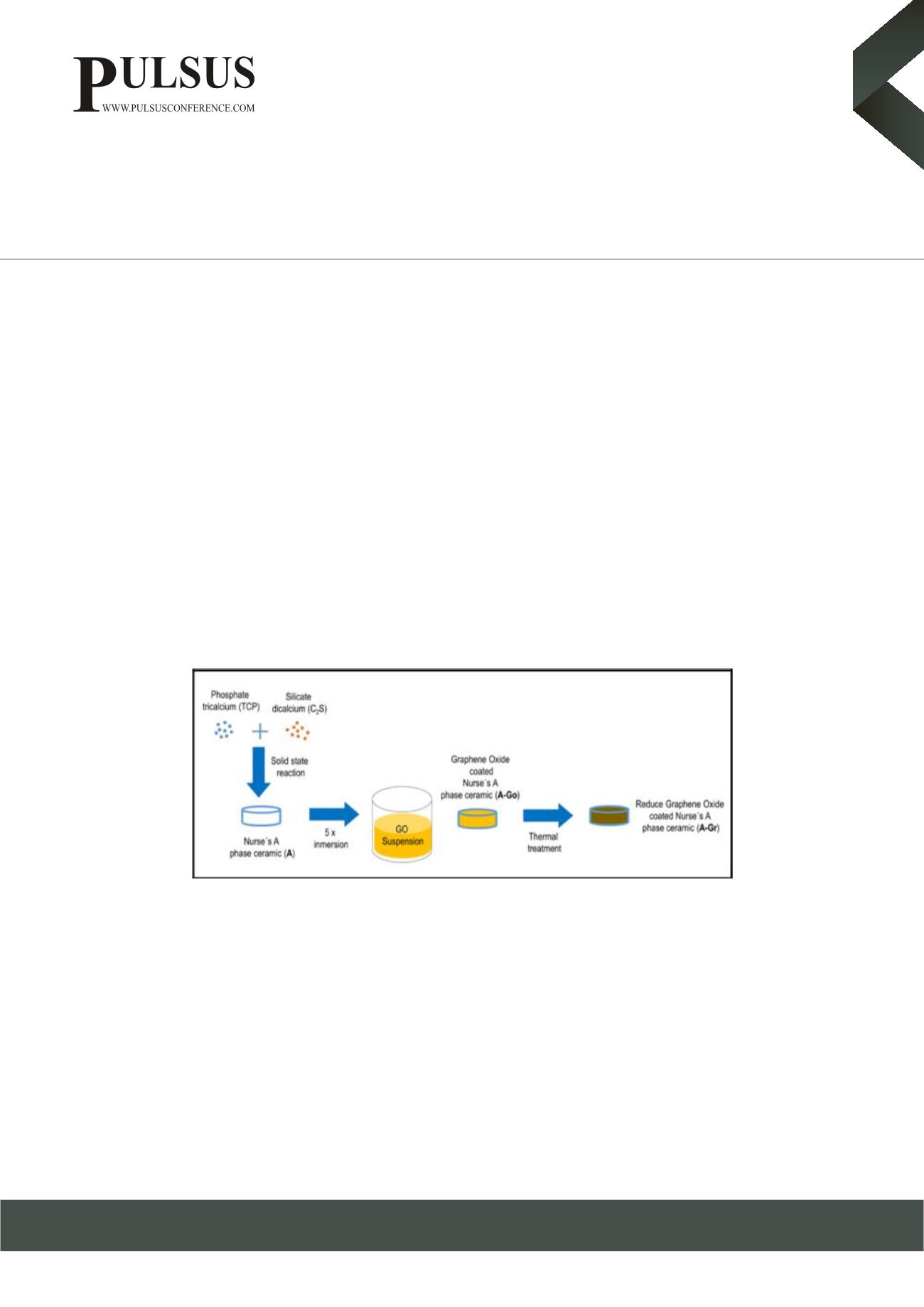
of a Si-Ca-P bioceramic, obtaining scaffolds totally covered by a thin layer of graphene oxide and reduced graphene oxide.
In
vitro
assays with adult human mesenchymal stem cells (
ah
MSCs) showed that A-Go stimulates cellular proliferation more than
A-Gr the first days of culture. This could support the theory of other researchers that indicates that Go mainly stimulates cell
proliferation, while r-Go favors cell differentiation.
Biography
Ruben Rabadan Ros is a Post-doctoral Researcher who has his expertise in Tissue Repair and passion in improving the health by the study of Organ and Tissue
Regeneration. In his short career, he has focused in bone, ligament and cartilage regeneration, and he has helped to develop scaffolds based on the C2S-TCP
phase diagram and combination bio-ceramics with fibroin, specially testing their biocompatibility and osteointegration by
in vitro
and
in vivo
studies.
rubenrabadanros@gmail.comRuben Rabadan-Ros et al., Arch Med 2018, Volume 10
DOI: 10.21767/1989-5216-C2-006
Figure: Synthesis of graphene coated Nurse´s A phase