ISSN : 2393-8854
Global Journal of Research and Review
The Nexus between Perceived Corruption, Macroeconomic Indicators, and Capital Flights in ASEAN-4 Countries
Ahmad Fauze Abdul Hamit*
Department of Business and Management, Universiti Teknologi MARA (UiTM), Shah Alam, Malaysia
- *Corresponding Author:
- Ahmad Fauze Abdul Hamit
Department of Business and Management, Universiti Teknologi MARA (UiTM), Shah Alam, Malaysia
E-mail: ahmad920@uitm.edu.my
Received date: December 30, 2024, Manuscript No. IPGJRR-24-20269; Editor assigned date: January 03, 2025, PreQC No. IPGJRR-24-20269 (PQ); Reviewed date: January 17, 2025, QC No. IPGJRR-24-20269; Revised date: July 07, 2025, Manuscript No. IPGJRR-24-20269 (R); Published date: July 14, 2025, DOI: 10.36648/2393-8854.12.2.125
Citation: Hamit AFA (2025) The Nexus between Perceived Corruption, Macroeconomic Indicators, and Capital Flights in ASEAN-4 Countries. Glob J Res Rev Vol:12 No:2
Abstract
Capital flight refers to the outflow of financial assets from a country due to various factors, including economic instability, political uncertainty, and perceived corruption. Understanding the determinants of capital flight is crucial for policymakers because it has significant implications for a country’s economic stability and growth. This study investigates the impact of the Corruption Perception Index (CPI) and macroeconomic indicators, such as the inflation rate, exchange rate, and Gross Domestic Product (GDP), on capital flights within four Southeast Asian countries or the ASEAN-4: Indonesia, Malaysia, The Philippines, and Thailand from 2010 to 2020. The current study hypothesises that countries with higher levels of perceived corruption, higher inflation rates, depreciating exchange rates, and lower GDP growth are more likely to experience higher levels of capital flight. The current study employs a static panel data regression analysis via the Feasible Generalised Least Squares (FGLS) model for more robust estimates. The analysis revealed a negative relationship between CPI scores and capital flight. Higher CPI scores indicate lower levels of corruption, increased investor confidence, and reduced levels of uncertainty. Conversely, a higher inflation rate positively influences capital flight, reflecting the erosion of purchasing power and reduced investor confidence. Additionally, the analysis also reveals that a depreciating exchange rate may discourage capital flight because it reduces the value of foreign assets held by domestic investors. Finally, higher GDP levels discourage capital flight, indicating a more robust domestic economy and better investment opportunities. Policy implications are derived from the empirical findings, suggesting that addressing corruption is crucial for achieving sustainable economic growth and curtailing capital flight.
Keywords
Capital flights; Corruption perception index; ASEAN-4; Macroeconomics
Introduction
Many developing countries have been seriously concerned about the problem of capital flight since the early 1980’s. This is because, among other things, it hurts how income is distributed and how well the public is treated. Capital flight is the act of moving money from one investment location to another in search of better opportunities or higher returns. When a country is experiencing unfavourable conditions, such as high inflation or political unrest. However, it occurs most frequently when currency instability exists. Most of the time, outflows are sizable enough to impact an entire nation's financial system. This phenomenon is terrible for the country because it affects its economy. This is especially true for developing countries, whose financial situation is often insufficient to withstand significant amounts of capital flight. As a result, there will be actual capital outflow and a further increase in foreign debt [1].
Capital flight was defined by Epstein as "The transfer of assets abroad to minimise loss of principal, loss of return, or loss of control over one's financial wealth due to governmentsanctioned activities." Some researchers concur that crossborder investment activities are the leading cause of capital flight, but others argue that such flight is linked to illegal activities. This can be seen in Erbe, the World Bank, and the Morgan Guaranty Trust Company, which connected capital flight to unrecorded capital outflows. On the other hand, Cumby and Levich argued that illegal capital outflows could also be viewed as capital flight.
Capital flight and capital flow are two different concepts, but they share one thing in common: They both involve international capital transfers. However, that is where their similarities end. Capital flows, such as foreign investments, are portfolio choices frequently made to take advantage of favourable capital returns, among other factors. On the other hand, capital flight refers to a decision to withdraw money and seek safety in another nation to evade social control. In other words, normal capital flows resemble a two-way street in which capital traffic is dual-directional and likely recorded in official statistics (i.e., the balance of payments).
In contrast, capital flight is more like a one-way street in which the flow of capital is typically unreported and removes. Capital inflows, such as external debt, may occasionally finance capital outflows. Nevertheless, capital outflows provide financing more frequently, reappearing as foreign investments (often to provide incentives extended to overseas investors). Therefore, significant capital flows between nations can occur without capital flight. It is also possible for a nation to experience zero capital outflows while experiencing massive capital outflows.
However, for at least three reasons, developing nations, including those with economies in transition, should pay particular attention to capital flight. First, because capital is in short supply in developing countries, the flight of capital worsens the situation. In addition, capital flight limits a country's capacity to access foreign and domestic resources. Thus, capital flight hinders economic growth and development and has many adverse effects. In other words, it promotes underdevelopment.
Second, capital flight can result in a negative feedback cycle. This is particularly true during crises and high levels of uncertainty. Economic growth will be further limited as resource constraints tighten, and there is a chance of losing access to outside sources of funding, which could result in more capital flight. As a result, it is increasingly challenging to implement economic policies and improve people's social conditions. In other words, capital flight makes it even more difficult to achieve the two objectives of economic growth and development. Capital flight pushes developing nations further down the economic ladder than they previously were. Capital flight poses a threat to the developing world.
Finally, a third reason is economic justice, specifically the distributional effects of capital accumulation and debt, as well as the legitimacy of external debt in and of itself. The rest of society suffers when elites misuse or inappropriately spend foreign debt. Nevertheless, it is more important to note that most societies bear the financial burden of capital flight and foreign debt. Regarding this, we must question the validity of external debt in itself and the justification for continuing to pay off debts that society did not benefit from (Figure 1).
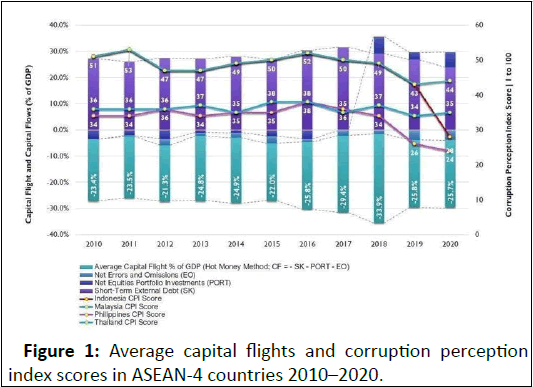
Figure 1: Average capital flights and corruption perception index scores in ASEAN-4 countries 2010–2020.
The latest economic literature does not continuously clarify what institutes capital flight, and the elusiveness of the term hampers the development of a theory of capital flight. Therefore, the theory of capital flight continues to evolve [2]. There are two alternative approaches in the literature to identify capital flight: Motivational and normative [3].
The motivational approach focuses on the reasons economic agents export capital. The motivational approach originated by Kindelberger and is rooted in the political and economic uncertainty of the domestic economy. The normative approach to measuring capital flight focuses on the macroeconomic consequences of capital flight, i.e., the negative effect on a country’s economic development. Ndiaye, Ndikumana and Boyce, and Ajayi note that the theory of capital flight proposes that the occurrence of capital flight is motivated by private players due to macroeconomic volatility, political and institutional uncertainty, a less developed financial system, and a greater rate of return variances abroad.
Public authorities also contribute to capital flight under circumstances of poor governance and inadequate institutional quality [4]. In such a situation, corrupt public authorities take advantage of their favourable position to accumulate personal fortunes abroad [5]. As these resources held overseas are local public resources, capital flight operated by public authorities leads to a decline in public resources, thereby encouraging a decline in public investment and, therefore, a decline in growth. According to this theory, in situations of poor governance and inadequate institutional quality, corrupt public authorities take advantage of personal wealth accumulation abroad [6].
Definition of capital flights and measures
The capital flights of each ASEAN country are calculated via the Hot Money or Narrow Measure established by Cuddington. It measures capital flight as the sum of SK (short-term capital or short-term external debt) and net (net errors and omissions) [7]. The hot money definition excludes long-term capital, but Cuddington includes EO because he argues that it accounts for unrecorded SK outflows. The basic formula based on this measure is as follows:
KFH=SK-PORT-EO
Where, KFH=Capital flight, SK=Short-term capital, PORT=Net portfolio equities, EO=Errors and omissions.
Corruption and capital flights
Corruption (from the Latin corruptio=decay) is one of the critical criteria for assessing the quality of governance, along with transparency and the rule of law. The World Bank has a short and straightforward definition of corruption: The abuse of public power for private benefit [8]. This refers to exchanging and delivering public services for payment, privileges, and undue compensation. In a way, something public (License, contract, tax break, subsidies, market share, bidding rights) is exchanged or sold for private gains (Speculation, insider information, contractual privileges, cash payments, or monopoly positions). The root of corruption is an arbitrary decision that translates into an unfair comparative advantage.
To broaden the scope of corrupt practices, we define corruption as rent-exacting power wielded by public agency officials with the aim of exchanging and delivering public services for personal gains and privileges. This involves a patronclient relationship. Although capital flight has received little attention until recently, its relationship with corruption has received even less attention in academic and professional circles. A large flow of research examines capital flight as a portfolio issue, with residents arbitraging between local and international assets on the basis of their relative expected risk/ return. Thus, capital flight stems from an almost endless array of domestic and external push/pull variables, including interest and exchange rates. However, little is known about the overall economic, sociopolitical, and institutional environment in the home country that might trigger capital outflows.
Domfeh et al., examined capital flight and institutional governance in sub-Saharan Africa (SSA): The role of corruption in thirty-two (32) countries in SSA for the period 2000-2012. The results of the empirical estimation prove that corruption has a positive and statistically significant influence on capital flight. Orkoh, Claassen, and Blaauw examined the influence of corruption control and political constancy on capital flight in SSA. The results indicate that at the 1% level of significance, a 1% increase in the corruption control score of a country reduces capital flight by approximately 1.5%. Abotsi conducted a study using secondary panel data obtained from Global Financial Indicators (GFI), World Development Indicators (WDI), and World Governance Indicators (WGI). The study revealed that corruption has a significant positive effect on capital flight. Trabelsi, Kharrat, and Feki analysed the root causes of capital flights in Tunisia via annual data between 1984 and 2014. The results indicate that corruption is a significant incentive for capital flight.
Macroeconomic indicators and capital flight Inflation rate: In their study of the relationship between inflation and capital flight, Harrigan et al., stated that inflation positively affects capital flight. However, Han et al., concluded that the inflation rate does not significantly affect Hong Kong’s capital flight. They also reported that interest rates are not significantly related to capital flight.
Exchange rate: The exchange rate is another important macroeconomic fundamental that could determine whether capital flight is high or low. Currency depreciation has been reported to have a significant positive effect on capital flight [9]. Pradhan and Gourishankar examined the determinants of capital flight in India from 1990-2012. The empirical results suggest that the exchange rate negatively and significantly influences capital flight. Cheung et al. examined China’s capital flight before and after crisis. These findings indicate that capital flight is positively influenced by exchange rate variability.
Ahmad and Sahto studied the relationship between capital flight in Pakistan and its determinants, including the exchange rate. The results of this study indicate that there is a positive relationship between capital flight and the exchange rate in the long term. To investigate whether a long-run relationship exists between real exchange rates and capital flight in Nigeria, Egbe used quarterly time series data from 1981-2009. The results show that capital flight and the real exchange rate are not significantly related.
Gross domestic product: Gross Domestic Product (GDP) has been found to have no significant relationship with capital flight. This finding is surprisingly contradictory to the belief that economic uncertainty contributes to increased capital flight. Capital flight has, however, been claimed to be negatively affected by economic growth and FDI activities. Claessens and Naude and Collier et al., managed to find a significant negative relationship between GDP and capital flight.
Salandy and Henry examined capital flight in Trinidad and Tobago before and after financial liberalisation. The results indicate that the GDP growth rate and capital flight have a positive and significant relationship. Forson et al., investigated capital flight in Ghana via the ARDL estimation technique. The results show that capital flight and the GDP growth rate have long- and short-run negative relationships. Uddin, Yousuf and Islam examined the factors that caused capital flight from Bangladesh for the period 1993-2013.
The findings indicate that the GDP growth rate has an insignificant relationship with capital flight in the two models. Pradhan and Gourishankar examined the causes of capital flight in India from 1990-2012. The empirical results show that capital flight and the GDP growth rate are positively and significantly related. Bekele examined the determinants of capital flight from nine Eastern African countries from 2006-2015. GDP growth had a negative effect on capital flight at the 5% significance level in Eastern African countries. A 1% change in economic growth is associated with a 0.95% change in capital flight.
Materials and Methods
Data collection
The current study collects data from each country’s current account to derive capital flights (hot money), including shortterm capital, net errors, omissions, and net portfolio investments comprising other bonds and corporate equities. Perceived corruption is based on the Corruption Perception Index (CPI) scores publicly available on the transparency international index website (Table 1).
| Data/variables | Description | Sources | Expected sign |
| Capital flights | A large-scale movement of financial assets and capital from a nation due to political or economic instability, currency devaluation, or the imposition of capital controls. | Key indicators for Asia and The Pacific 2022 | Hot money=-SK-PORT-EO |
| Perceived corruption | An index that ranks countries according to perceived levels of government corruption. Scores range from zero to 100, with zero indicating high corruption and 100 indicating low corruption. | Transparency international index | Negative (-) |
| Inflation rate | The rate of price increase over a given period. | Refinitiv Eikon Database | Positive (+) |
| Exchange rate | The rate at which one currency is exchanged for another. | Refinitiv Eikon Database | Negative (-) |
| Gross domestic product | The monetary value of final goods and services, that is, those purchased by the final user in a country during each period. | Refinitiv Eikon Database | Negative (-) |
Table 1: Summary of data for each variable.
Methodology
The present study employs a static generalised least squares panel regression analysis via STATA software. Tests carried out before fitting the models included data normality tests, stationarity tests via the Harrisâ??Tzavalis test, and multicollinearity tests. Upon estimation of the regression model, postestimation diagnostic tests were carried out to determine the fitness of the fitted models. They included model fitness tests, such as the Variance Inflation Factor (VIF) test for multicollinearity, the modified Wald test for heteroskedasticity, and the Wooldridge test for autocorrelation.
Results and Discussion
The results and discussion section should provide details of all the findings that are required to support the conclusions of this paper. The discussion should be concise and tightly argued (Table 2).
| Variables | CF | PCOR | INF | EXCH | GDP | Harris-Tzavalis test | Order |
| CF | 1 | (0.3925)*** | I (0) | ||||
| PCORR | 0.3925*** | 1 | (0.3585)*** | I (0) | |||
| INF | .7480*** | .6522*** | 1 | (0.5270)** | I (0) | ||
| EXCH | .5343*** | .4120*** | .6774*** | 1 | (0.2710)*** | I (1) | |
| GDP | -0.0664 | -.154*** | -0.1053 | -.2181*** | 1 | (0.1460)*** | I (0) |
| Notes: I (0) denotes the level order of stationarity, and I (1) represents the data series stationary at the first-order difference. | |||||||
Table 2: Pairwise correlation matrix and data stationarity.
The results of the Feasible Generalised Least Squares (FGLS) regression analysis presented in Table 3 offer essential insights into the relationships among perceived corruption, the inflation rate, the exchange rate, Gross Domestic Product (GDP), and an unspecified dependent variable derived from a sample of 44 observations. The analysis reveals a robust negative correlation between perceived corruption and the dependent variable, with a coefficient of -0.839, a z-statistic of -7.32, and a p-value of 0.000, indicating strong statistical significance. This finding suggests that as perceptions of corruption increase, the dependent variable significantly decreases, aligning well with the literature that posits that corruption undermines economic performance and social trust. In contrast, the inflation rate has a positive coefficient of 2.699, a z-statistic of 4.85, and a p-value of 0.000, indicating that rising inflation correlates positively with the dependent variable and that moderate inflation may stimulate economic activity as consumers anticipate future price increases. This outcome challenges traditional views on inflation and highlights a complex relationship wherein inflation could yield beneficial effects on economic performance under certain conditions.
| Variable | Coef. | z-stat | P>| z | | Results |
| Perceived Corruption | -0.839 | -7.32 | (0.000)*** | Negative and significant results |
| Inflation rate | 2.699 | 4.85 | (0.000)*** | Positive and significant results |
| Exchange rate | -21.52 | -1.88 | (0.06)* | Negative and significant results |
| Gross domestic product | -0.663 | 1.2 | 0.229 | Negative and insignificant |
| Constant | 46.78 | 3.65 | (0.000)*** | |
| Time effects | Included | |||
| Modified Wald Test | 2.31 (0.6796) | No heteroscedasticity | ||
| Wooldridge Test | 3.16 (0.1735) | No autocorrelation | ||
| Mean VIF Test | 2.83 | No multicollinearity | ||
| No. of observations | 44 |
Table 3: Feasible generalised least squares regression analysis results.
The exchange rate is shown to have a negative association with the dependent variable, with a coefficient of -21.52 and a p value of 0.06, indicating significance at the 10% level. This suggests that currency depreciation may adversely affect the dependent variable, likely affecting the competitiveness of domestic industries and import reliance. However, GDP has a negative coefficient of -0.663 but is not significant (p=0.229), indicating that it does not meaningfully influences the dependent variable, which may reflect additional underlying factors not captured by GDP alone. The constant term in the model is significant, with a coefficient of 46.78, indicating the baseline level of the dependent variable when all independent variables are held constant. The reliability of the model was further supported by diagnostic tests. The modified Wald test indicated no heteroscedasticity (p=0.6796), the Wooldridge test showed no autocorrelation (p=0.1735), and the mean Variance Inflation Factor (VIF) test indicated no severe multicollinearity, with a mean VIF of 2.83.
These findings offer crucial implications for policymakers, emphasising the need for greater transparency and integrity in governance to mitigate the adverse effects of perceived corruption and suggesting that moderate inflation could play a role in stimulating economic growth. Additionally, the significant but limited effects of the exchange rate warrant attention to trade policies, whereas the mixed results concerning GDP call for further investigation into its relevance and potential limitations as a metric in this context. Overall, the study contributes to a nuanced understanding of the complex interrelationships among these economic variables, indicating that decisions surrounding these factors can profoundly impact economic performance. Future research can enhance these findings by incorporating additional variables and qualitative analyses to explore the contextual dynamics that influence the relationships observed in this regression analysis.
Conclusion
The nexus between perceived corruption, macroeconomic indicators, and capital flight in ASEAN-4 countries Indonesia, Malaysia, The Philippines, and Thailand reveals critical interplay that profoundly impacts economic stability and development. This study reveals a strong correlation between higher levels of perceived corruption and increased capital outflows, underscoring the destabilising effects of corruption on investor confidence and economic integrity. The evidence suggests that corruption erodes the trust necessary for sustained investment, leading individuals and businesses to move capital to safer environments, thus worsening capital flight. The role of governance is paramount because robust institutional frameworks and anticorruption measures are essential to mitigate these effects. Weak governance structures not only intensify corruption perceptions but also facilitate conditions conducive to capital flight, further undermining economic stability.
Macroeconomic factors, particularly inflation and exchange rates, also play significant roles in flight dynamics. This study highlights that higher inflation rates are associated with greater capital outflows, likely due to the erosion of domestic purchasing power and the desire to safeguard assets in more stable currencies. Conversely, depreciating exchange rates appear to reduce capital flight by diminishing the value of foreign-held assets, making domestic assets more attractive. However, the relationship between GDP growth and capital flight is complex, while a negative correlation exists, it is not statistically significant, suggesting that economic growth alone may not be sufficient to counteract the effects of corruption and other macroeconomic pressures on capital flight.
The findings emphasise the necessity of a dual focus on governance reforms and macroeconomic stabilisation. Effective policy measures should enhance institutional integrity and reduce corruption perceptions while maintaining macroeconomic stability through prudent fiscal and monetary policies. By addressing these interconnected factors, ASEAN-4 countries can mitigate capital flight, support sustainable economic growth, and achieve greater long-term economic resilience.
Conflict of Interests
The authors declare no conflict of interest.
Data Availability Statement
The data for Perceived Corruption score is derived publicly from Transparency International. Corruption Perceptions Index. Transparency.org. https://www.transparency.org/en/cpi
The data for Macroeconomic Indicators are derived from Refinitiv Eikon. (2023). (GDP growth rates, annual, 2000-2023).
References
- Abalkin A, Whalley J (2002) The problem of capital flight from Russia. World Econ 25:421-444
- Bardhan P (1997) Corruption and development: A review of issues. J Econ Lit 35:1320-1346
- Boyce JK, Ndikumana L (2001) Is Africa a net creditor? New estimates of capital flight from severely indebted sub-Saharan African countries, 1970-1996. J Dev Stud 38:27-56
- Cerra V, Rishi M, Saxena SC (2008) Robbing riches: Capital flight, institutions, and debt. J Dev Stud 44:1190-1213
- Erbe S (1985) The flight of capital from developing countries. Intereconomics 20:268-275
- Gibson HD, Tsakalotos E (1993) A flow model of capital flight was tested in five European countries. Manch Sch 61:144-166
- Ketkar SL, Ketkar KW (1989) Determinants of capital flight from Argentina, Brazil, and Mexico. Contemp Policy Issues 7:11-29
- Khan MS, Haque NU (1985) Foreign borrowing and capital flight: A formal analysis. Staff Papers 32:606-628
- Le QV, Rishi M (2006) Corruption and capital flight: An empirical assessment. Int Econ J 20:523-540

Open Access Journals
- Aquaculture & Veterinary Science
- Chemistry & Chemical Sciences
- Clinical Sciences
- Engineering
- General Science
- Genetics & Molecular Biology
- Health Care & Nursing
- Immunology & Microbiology
- Materials Science
- Mathematics & Physics
- Medical Sciences
- Neurology & Psychiatry
- Oncology & Cancer Science
- Pharmaceutical Sciences