


 9 / 12

4
t h
E u r o S c i C o n C o n f e r e n c e o n
Neurology & Neurological
Disorders
Journal of Neurology and Neuroscience
ISSN: 2171-6625
J u l y 1 2 - 1 3 , 2 0 1 8
P a r i s , F r a n c e
Neurology 2018
Page 43
T
heobjectiveofcurrentworkistoemphasizeontheimpactofneurorehabilitation
as a contemporaneous approach to Brain Activation. The goal was to prove
and evaluate the efficacy of application of different modalities and methods of the
physical and rehabilitation medicine (PRM) on independence and quality of life of
neurological and neurosurgical patients. We effectuated a composition, clinical
application and approbation of complex neurorehabilitation algorithms in patients
with neurological and with neurosurgical conditions. Patients were divided into a
lot of groups and subgroups, in each one we applied a different neurorehabilitation
complex, composed by a synergic combination of natural and pre-formed physical
modalities (electrical currents, laser, cryo/thermo-agents, hydro-/balneo-/ peloido-
therapy; physiotherapy and occupational therapy). Patientswere controlled before,
during and at the end of the neurorehabilitation course and one month after its
end - using a battery of traditional and contemporaneous objective methods: tests
and scales for motor deficiency, balance and coordination; functional grip of the
upper limb; gait and independent motion; independence in activities in daily living
(ADL: self-service, family, professional and social life); depression and anxiety;
visual analogue scale of pain; vibroesthesiometry; thermosensibility; laser Doppler
flowmetry; ICF assessment. Based on detailed qualitative and quantitative
evaluation, we proved the efficacy of application of different neurorehabilitation
programmes – on different types and levels of sensory, motor and functional
deficiency. In conclusion, we emphasize on the capacity of physical modalities
for functional recovery and amelioration of independence in everyday life of
patients with diseases and conditions of the nervous systems. Our opinion (based
on 30 years clinical practice) is that neurorehabilitation must be considered as
an important approach to brain activation and must be involved in the everyday
clinical practice of neurological and neurosurgical wards.
Biography
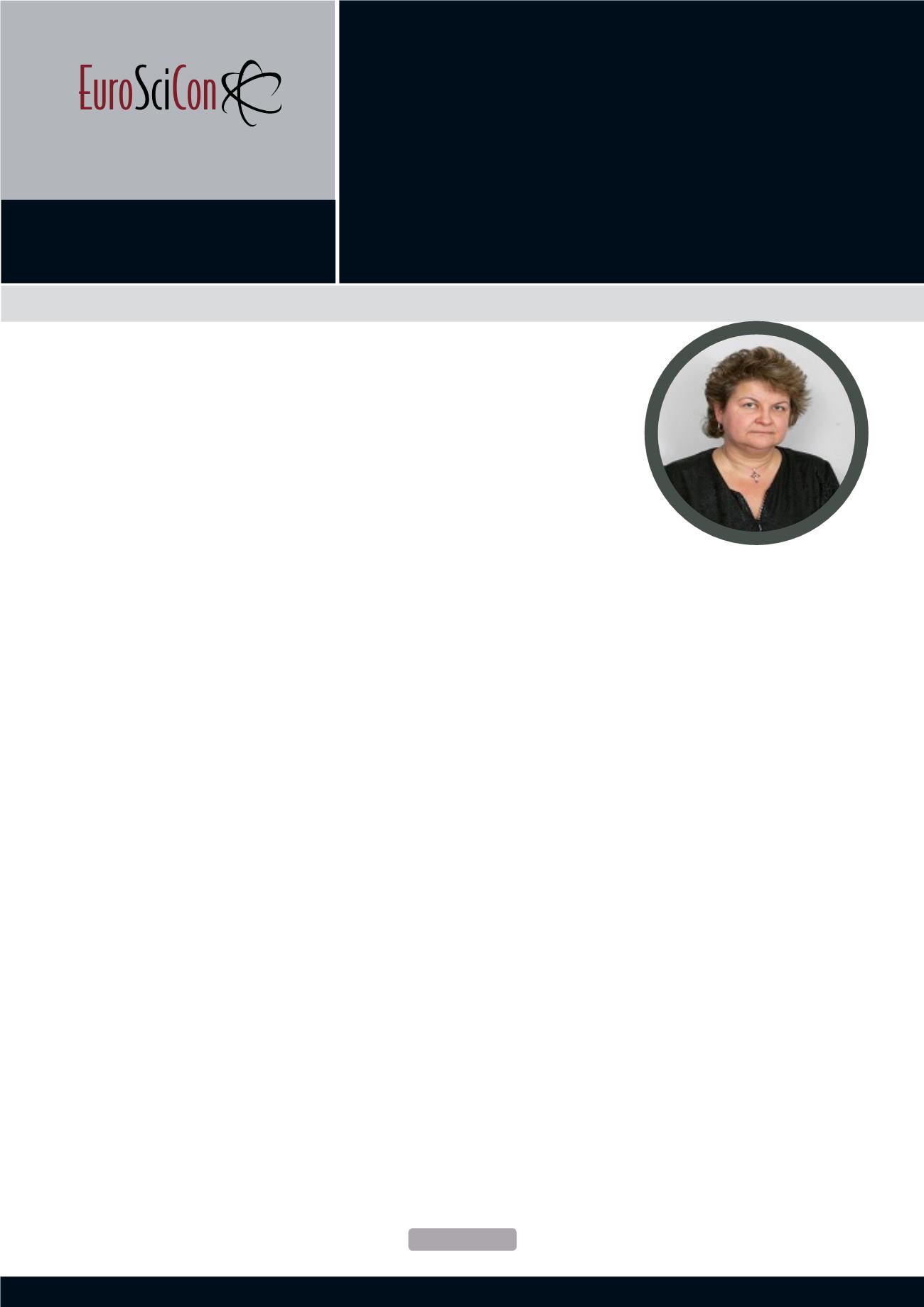
Ivet B Koleva is a Medical Doctor, Specialist in Neurology, Phys-
ical and Rehabilitation Medicine (PRM) with European certifica-
tion in PRM. She has completed three scientific theses: PhD in
PRM, PhD in Pedagogics, Doctor of Medical Sciences in PRM
[PhD thesis on Physical Prevention and Therapy of Diabetic
Polyneuropathy; thesis for Doctor-es-Medical Sciences on Neu-
rorehabilitation in patients with socially important neurological
diseases]. She has published more than 100 papers in Bulgar-
ian and international scientific journals, author of monographs
and manuals in the fields of Physical Medicine, Neurorehabilita-
tion, Neuro-ergotherapy, Grasp and Gait rehabilitation, Function-
al evaluation, Pain management. She is a Member of national
and international associations of PRM. She is the President of
Bulgarian Neurorehabilitation Society and Editor-In-Chief of the
Bulgarian scientific magazine Neurorehabilitation (from 2006).
Actually, she is Professor at the Medical University of Sofia, Bul-
garia.
yvette@cc.bas.bgNeurorehabilitation - a modern approach to
brain activation (Impact on quality of life of
neurological and neurosurgical patients
Ivet B Koleva
1
, Borislav R Yoshinov
2
and
Radoslav D Yoshinov
3
1
Medical University of Sofia, Bulgaria
2
Sofia University, Bulgaria
3
Bulgarian Academy of Sciences – Sofia, Bulgaria
Ivet B Koleva et al, J Neurol Neurosci 2018, Volume: 9
DOI: 10.21767/2171-6625-C1-007