


 3 / 12

4
t h
E u r o S c i C o n C o n f e r e n c e o n
Neurology & Neurological
Disorders
Journal of Neurology and Neuroscience
ISSN: 2171-6625
J u l y 1 2 - 1 3 , 2 0 1 8
P a r i s , F r a n c e
Neurology 2018
Page 19
Purpose:
To evaluate the effect of low-intensity photo-stimulation with complex-
structured optical signals on visual functions in patients with glaucoma.
Methods
: For the stimulation, LED emitters embedded in virtual reality glasses
were used, which forms light signals of complex structure with a given fractal
dimension. In groups with suspected glaucoma (4 eyes), early primary open-angle
glaucoma (POAG Ia, n=5), POAG IIa (n=13), and POAG IIIa (n=17), light stimulation
was applied daily: course included 10 séances of 10min. Before and after the
course of fractal stimulation, visual fields and colour recognition were examined
with standard automatic perimetry (SAP) and the Farnsworth Munsell 100 Hue
Colour Vision Test (FM).
Results:
In the SAP, mean deviation (MD), which in norm should not exceed −2 dB,
before / and after the treatment in averaging for groups of suspected glaucoma,
POAG Ia, IIa and IIIa were, respectively, -0.48/-0.43dB, -1.68/-1.38dB, -3.42/-
1.75dB, and -14.37/-9.98dB. The pattern standard deviation (PSD) before / and
after the treatment for groups with suspected glaucoma, POAG Ia, IIa, and IIIa
were, respectively, -1.87/-1,76dB, -1.84/-1.77dB, -1.99/-1.89dB and -6.58/-6.28dB.
The FM test was applied to estimate the errors in recognition of green, blue, yellow
colours (TES). Before / and after the treatment, the TES data for four mentioned
groups consisted, respectively, -12.00/-7,50, -13.60/-11,40, -20.62/-18,62, and
-36.53/-32,35.
Conclusion:
Low-intensive fractal photo-stimulation significantly improves the
SAP indices and colour recognition in eyes with different stages of glaucoma.
The pronounced effect of fractal stimulation for the advanced POAG can indicate
that at any stage of glaucoma, in the general population of ganglion cells there
is a significant percentage of cells that are yet at the plastic phase of reversible
functional changes and capable of responding positively to medical or physical
neuroprotective therapy. Further confirmation of the stability of effects is required
in studies on a more massive cohort.
Biography
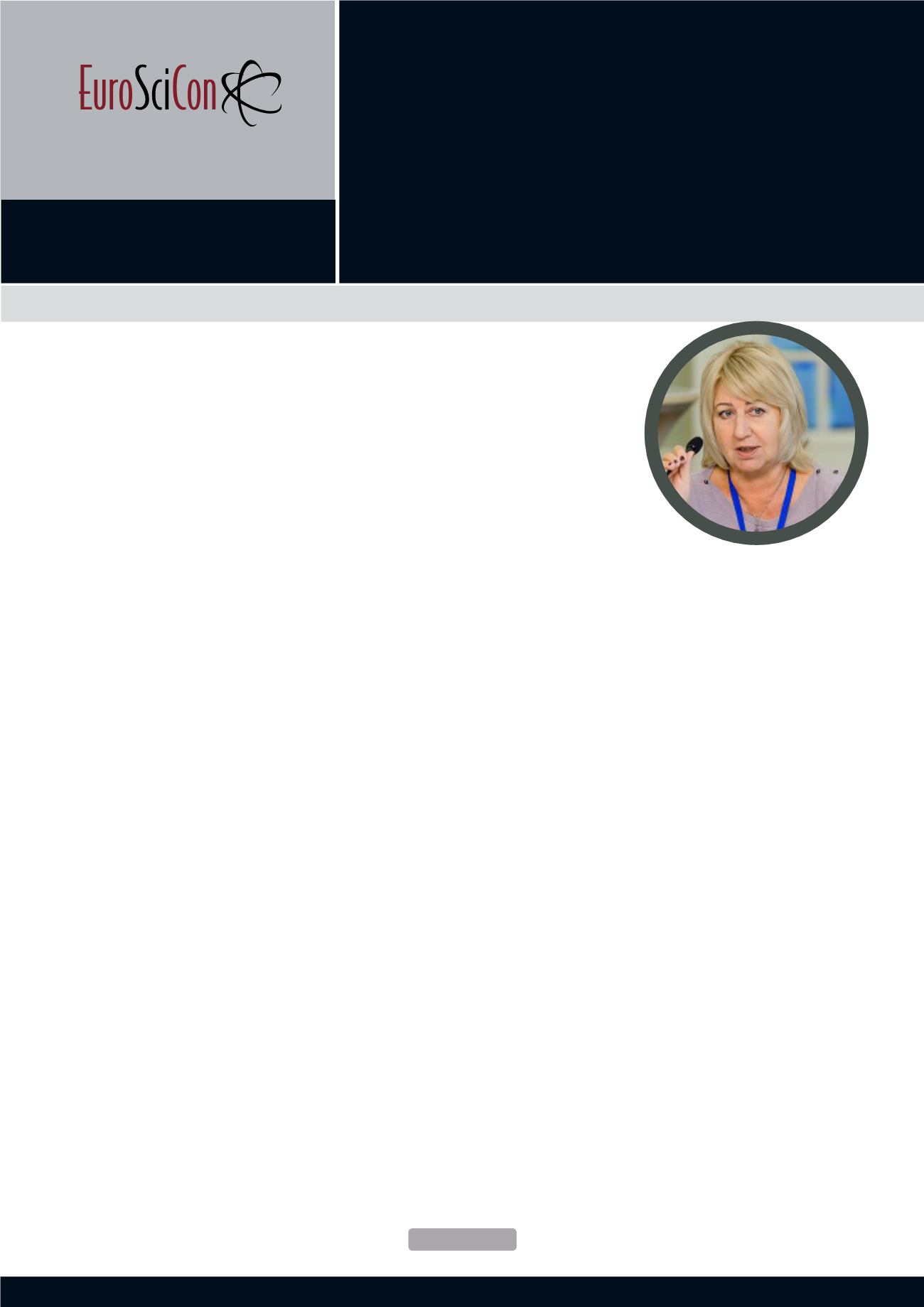
Marina V Zueva, Professor of Pathophysiology received her PhD
and Biological Science D fromMoscow Helmholtz Research In-
stitute of Eye Diseases. Currently, she is the Head of the Divi-
sion of Clinical Physiology of Vision at the Moscow Helmholtz
Research Institute of Eye Diseases. She is a member of Inter-
national Society of Clinical Electrophysiology of Vision (ISCEV),
European Association on Vision and Eye Research (EVER), Eu-
ropean Society of Retina Specialists (EURETINA), Society for
Research on Biological Rhythms (SRBR). She has published
over 15 peer-reviewed full-length papers in English (over 100 in
Russian) and presented near 70 topics at international confer-
ences.
visionlab@yandex.ruStimulation therapy of glaucoma by
complex-structured (fractal) optical
signals
Marina V Zueva
1
, Maria A Kovalevskaya
2
, Olga
V Donkareva
2
, Maria A Starikova
2
, Alexander I
Karankevitch
3
and Alex A Taranov
3
1
Moscow Helmholtz Research Institute of Eye Diseases, Moscow, Russia
2
NN Burdenko Voronezh State Medical University, Voronezh, Russia
3
Moscow State Technical University, Moscow, Russia
Marina V Zueva et al, J Neurol Neurosci 2018, Volume: 9
DOI: 10.21767/2171-6625-C1-007