


 10 / 12

4
t h
E u r o S c i C o n C o n f e r e n c e o n
Neurology & Neurological
Disorders
Journal of Neurology and Neuroscience
ISSN: 2171-6625
J u l y 1 2 - 1 3 , 2 0 1 8
P a r i s , F r a n c e
Neurology 2018
Page 44
A
fter focal ischemic injury of brain such as stroke, activity of remaining neural network is changed to optimize neural resources for
recovery of function. Neuroplasticity plays an important role in coordinating neural interactions on different levels from cellular
changes to wide-range cortical remapping for recovery from ischemic brain injury such as stroke. An experience-dependent synaptic
and circuit plasticity remodels synaptic buttons and connections by repeated sensory experience. Modulation of neuroplasticity
may enhance the rehabilitative outcome and functional restoration after stroke; therefore, it is a crucial topic of neurorehabilitation.
Noninvasive brain stimulation (NBS) has recently been adopted for modulating neural excitability in a noninvasive manner and
consequently enhancing neural recovery after stroke. The most popular noninvasive methods of neuromodulation include transcranial
magnetic stimulation (TMS), transcranial direct current stimulation (tDCS), and transcranial alternating current stimulation (tACS). After
a stroke, interhemispheric imbalance of cerebral cortical excitability occurs and cortical activity in the contralesional hemisphere is
abnormally increased. On the other hand, brain activity in the ipsilesional hemisphere is decreased by interhemispheric inhibition of the
contralesional hemisphere. NBS has been used to recover disrupted interhemispheric balance caused by stroke onset by modulating
cortical excitability over specific brain regions. Cortical excitability can bemodulated depending on the frequency of rTMS and the tDCS
direction of current. This intervention can lead to the improvement of residual motor function by inducing neural plasticity. NBS has
been mainly performed to restore abnormal interhemispheric balance by facilitating ipsilesional primary motor cortex (M1) excitability
or by inhibiting contralesional M1 excitability. Recently, more challenging approaches, such as stimulation of two or more sites or use
of dual modalities have been studied in stroke patients. One of the considerations on the effect of NBS is individual variation of its
responsiveness. Diverse factors such as individual skull and cortical morphology, lesion location and severity, genetic polymorphism,
etc. are considered as the intrinsic factors affecting individual response variability. The individually-tailored neural network modulation
by customized NBS technique considering multiple influencing factors may enhance functional recovery and provide successful
neurorehabilitation outcome after stroke. The modulating effect of NBS can expand to the interconnected subcortical network areas
beyond the site of cortical stimulation. Use of multimodal functional neuroimaging methods such as functional magnetic resonance
imaging (fMRI), diffusion tensor imaging (DTI), electroencephalography (EEG), functional near infrared spectroscopy (fNIRS) can
demonstrate the network effect of NBS. Neural plasticity after stroke can be seen from microscopic to macroscopic levels. This
process may be spontaneous or induced by training, although the former occurs only within a critical period after injury. A novel
neurorehabilitation strategy of using personalized NBS methods in combination with various rehabilitation techniques can further
maximize functional recovery after stroke.
Biography
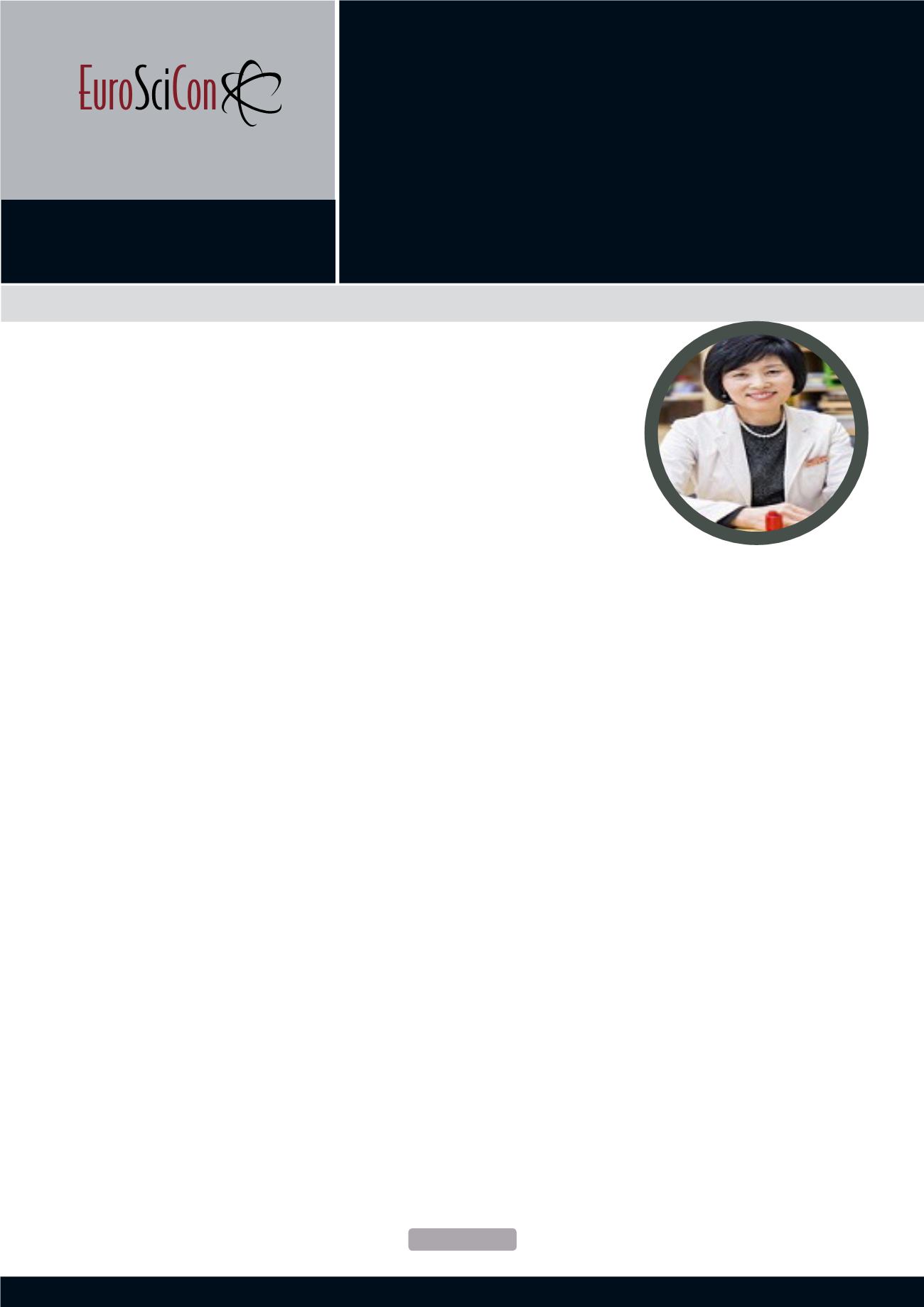
Yun- Hee Kim of Samsung Medical Center, Seoul has an expertise in Rehabilitation. She is Professor at the Department of Physical and Rehabilitation Medicine, Sungkyunkwan
University. Her Research interest includes, Stroke, Brain Injury, Vascular Dementia, Sensorimotor Rehabilitation, Cognitive Rehabilitation, Speech Rehabilitation and Central Pain.
She had completed her PhD in 1996, from Yonsei University Graduate School, Department of Neuroanatomy.
yun1225.kim@samsung.comNoninvasive brain stimulation for
enhancing recovery after stroke
Yun Hee Kim
1, 2
1
Department of Physical and Rehabilitation Medicine, Samsung Medical
Center, Sungkyunkwan University School of Medicine, Seoul, Korea
2
Stroke and Cerebrovascular Center, Samsung Medical Center,
Sungkyunkwan University School of Medicine, Seoul, Korea
Yun Hee Kim, J Neurol Neurosci 2018, Volume: 9
DOI: 10.21767/2171-6625-C1-007