


 13 / 32

Polymer Congress 2018
Polymer Sciences
ISSN: 2471-9935
Page 67
June 04-05, 2018
London, UK
4
th
Edition of International Conference on
Polymer Science and
Technology
A
s the use of absorbent disposable items such as sanitary
napkins and diapers have increased, environmental
problems related to waste disposal have been concerned. To
resolve this problem, we can use eco-friendly superabsorbent
polymer (SAP) with bio-based monomer replacing petroleum
based SAP. However, bio-based SAPs have low water
absorption properties. In this study, we studied the effects
of post-treatment processes to enhance the performances
of SAPs. The SAPs were prepared using itaconic acid, vinyl
sulfonic acid, tetraethylene glycol diacrylate and ammonium
persulfate initiator. Various post-treatment processes
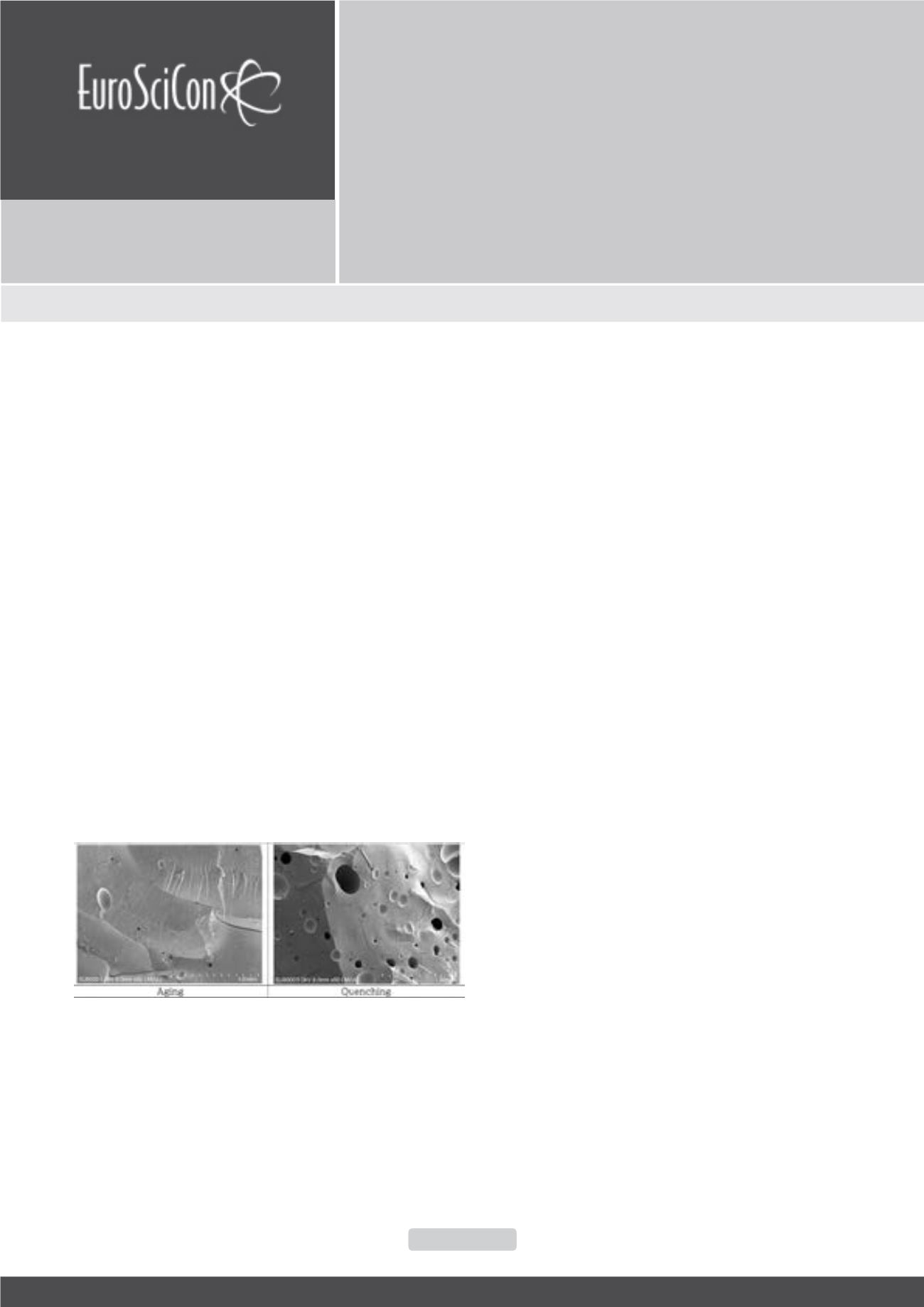
(Quenching, Aging, and Annealing) are investigated. After post-
treatment processes, we measured free water absorbency,
centrifuge retention capacity, and absorption under load of
the SAPs. The structure of SAPs was confirmed by FT-IR. The
amount of monomer residues of SAP was confirmed by HPLC.
Recent Publications
1. GAO, Jiande, et al. Preparation and properties of novel
eco- friendly superabsorbent composites based on raw
wheat bran and clays. Applied Clay Science, 2016, 132:
739-747.
2. BANEDJSCHAFIE, Schahram; DURNER, Wolfgang. Water
retention properties of a sandy soil with superabsorbent
polymers as affected by aging and water quality. Journal
of Plant Nutrition and Soil Science, 2015, 178.5: 798-806.
3. ZHOU, Zhiling; YANG, Zhaozhong; LIU, Chaoping. Novel
nanocomposite super absorbent polymers reinforced by
clay nanosheets. Russian Journal of Applied Chemistry,
2016, 89.2: 324- 329.
4. KIM, Hyun Jae, et al. Synthesis of super absorbent
polymer using citric acid as a bio-based monomer.
Polymer Degradation and Stability, 2017, 144: 128-136.
5. GUO, Jian-Zhong, et al. Removal of methylene blue from
aqueous solutions by chemically modified bamboo.
Chemosphere, 2014, 111: 225-231.
Biography
Seokju Hong earned a bachelor’s degree from Yonsei University. He is in
the master’s course from Hanyang University. His bachelor’s major was
packaging and the master’s major is a chemical engineering. He wants to
be an expert in the polymer field. He is currently working at Korea Institute
of Industrial Technology (KITECH). He is studying SAP and using various
methods to perform synthesis and analysis to improve the absorbency of
SAP.
tjrwn523@kitech.re.krSeokju Hong et al., Polym Sci 2018, Volume 4
DOI: 10.4172/2471-9935-C2-012
Post-treatment process to enhance the performances of super
absorbent polymers
Seokju Hong
1
, Byeong Kwan Kang
1
, Jungsoo Kim
1
, JinHoon Kim
1
, JiEun Jang
1
,
Youngwook Chang
2
and
Donghyun Kim
1
1
KITECH, Republic of South Korea
2
Hanyang University, Republic of South Korea