


 15 / 32

Polymer Congress 2018
Polymer Sciences
ISSN: 2471-9935
Page 69
June 04-05, 2018
London, UK
4
th
Edition of International Conference on
Polymer Science and
Technology
T
he higher silica content in the tire-tread rubber can
maximize the efficiency of the vehicle. However, silica
does not mix well with other mixtures, including the tire-tread
rubber. This phenomenon deteriorates the various properties
of the tire-tread rubber. Therefore, we have tried to improve
the dispersity of silica in tire-tread rubber by using dispersant.
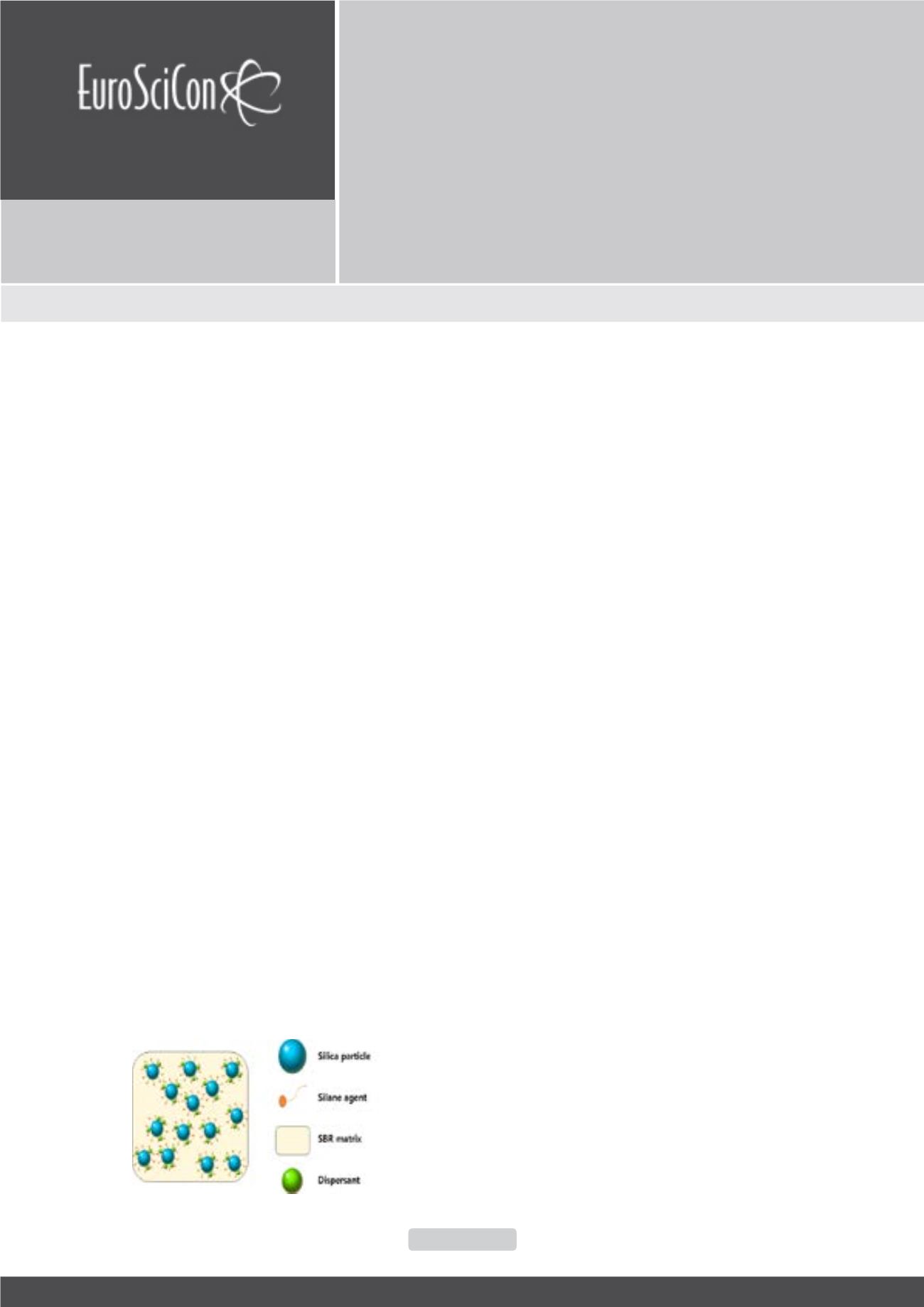
The dispersion of silica in tire-tread styrene-butadiene rubber
(SBR) is one of important factors in the mechanical properties
of it. We prepared dispersants to enhance silica content and
dispersity in SBR using wet master batch (WMB) system. The
dispersants were prepared by copolymerization of styrene with
allyl alcohol or methyl methacrylate. The synthetic conditions
of dispersants were changed to improve the silica loading
content and dispersity in WMB system for the preparation of
silica-SBR composites. The WMB system was consisted of
the steps involving dispersants synthesis, silica modification,
dispersion of modified silica in SBR emulsion latex, and
coagulation of silica-SBR composites. We confirmed the
structure of the dispersants using FT-IR. The content of silica in
the composites was measured by thermal gravimetric analysis
(TGA) according to the types of dispersants. We also studied
the payne effect with rubber process analyzer (RPA) instrument
and dynamic viscoelasticity with Dynamic mechanical analysis
(DMA) instrument. We measured the mechanical properties of
them such as tensile strength and modulus of M300. We found
the optimal types and content of dispersants for silica-SBR
composites.
Recent Publications
1. Bourgeat Lami E, Espiard Ph and Guyot A (1995) Poly
(ethyl acrylate) latexes encapsulating nanoparticles
of silica: 1. functionalization and dispersion of silica.
Polymer. 36.23:4385-4389.
2. Choi Sung Seen, Park Byung Ho and Song Hanjong
(2004) Influence of filler type and content on properties
of styrene‐butadiene rubber (SBR) compound
reinforced with carbon black or silica. Polymers for
Advanced Technologies. 15.3:122-127.
3. Choi Sung Seen, Nah Changwoon and Jo Byung
Wook (2003) Properties of natural rubber composites
reinforced with silica or carbon black: influence of
cure accelerator content and filler dispersion. Polymer
International. 52.8:1382-1389.
4. Yan Gui et al. (2016) Preparation and performance
of silica/SBR masterbatches with high silica loading
by latex compounding method. Composites Part B:
Engineering. 85:130-139
5. Byeongho Seo et al. (2013) Characterization of AN-
SBR/Silica compound with acrylonitrile as a polar
group in SBR. Macromolecular Research. 21(7):738-
746.
Biography
Byeongkwan Kang is currently pursuing Master’s Degree in Chemical
Engineering at Hanyang University, Republic of South Korea. He is
also working at Korea Institute of Industrial Technology (KITECH). Our
company research Institute of Industrial Technology Convergence leads
Industry Convergence Technology and explores future growth engines to
drive the economy by developing and commercializing intelligent robots,
high-tech medical fibers, ultra-precision nanotechnology, wellness
systems, and packaging technology. He is mainly interested in polymer
chemistry such as hydrogel.
90kbk@kitech.re.krB K Kang et al., Polym Sci 2018, Volume 4
DOI: 10.4172/2471-9935-C2-012
The silica dispersing effects of silica-SBR composites with
dispersing agent: poly(styrene-allyl alcohol) and poly(styrene-
methyl methacrylate)
B K Kang
1
, M S Kim
1
, J S Kim
1
, Y W Chang
2
and
D H Kim
1
1
KITECH, Republic of South Korea
2
Hanyang University, Republic of South Korea