


 4 / 5
4 / 5

Volume 10
Journal of Archives of Medicine
Advanced Biotechnology & Annual Pediatrics 2018
November 28-29, 2018
Page 15
Novel Trends and Advances in Biotechnology,
Cell & Stem Cell Research
15
th
Annual Congress on Pediatrics
World Congress on
&
November 28-29, 2018 Barcelona, Spain
Joint Event On
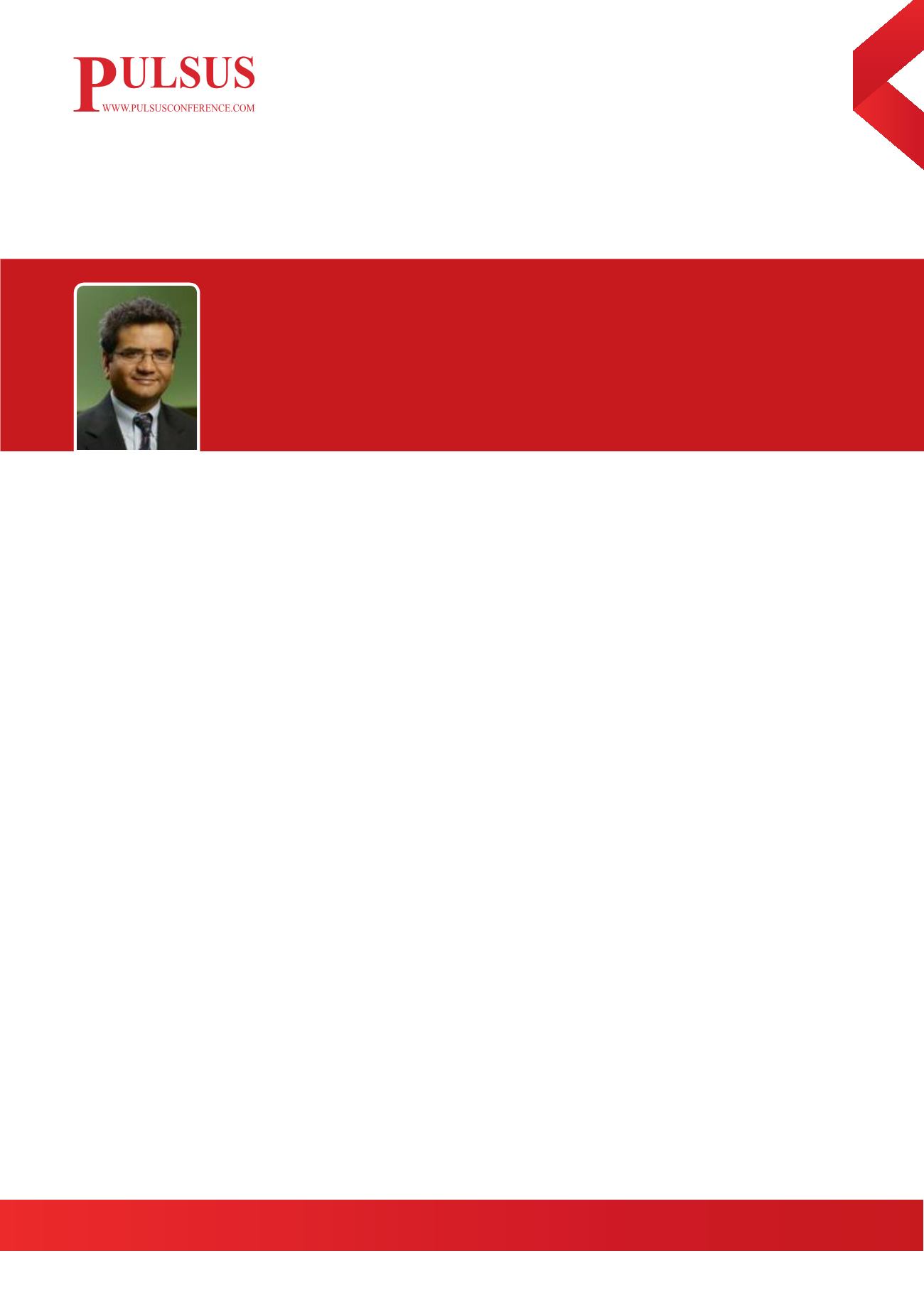
R T Kamble
Baylor College of Medicine, USA
Orthotopic heart transplant facilitated autologous hematopoietic stem cell transplantation for light-
chain amyloidosis
Objective:
Dominant cardiac involvement by primary systemic amyloidosis (AL) precludes effective AL treatment and is
associated with short survival. We evaluated long term outcomes of these patients receiving Orthotopic Heart Transplantation
(OHT) and Autologous Hematopoietic Stem Cell Transplantation (ASCT).
Methods:
Between January 2009 and July 2018, total of 14 patients who presented with severe cardiac dysfunction as their major
manifestation of AL underwent OHT. Eight of these 14 patients received ASCT. All patients had end stage heart failure and
developed cardiogenic shock requiring intra-aortic balloon pump support (median 20 days, range 10-165) as a bridge to OHT.
Results:
The median age at AL presentation was 54 years (42-63) in 7 females and 7 males. At median follow-up of 55 months
(1-104) from OHT, 10 (71 %) patients are alive. Two patients died of post-operative complications at 1 and 7 months post OHT;
2 patient died 36 and 104 months after OHT (23 and 91 months post ASCT) of AL progression. Eight patients received ASCT
at median of 13 months (13-34) after OHT. Treatment for disseminated cryptococcus delayed ASCT in one patient (#8). One
patient awaits ASCT in June 2018. In the remaining 3 patients ASCT was not feasible due; to low DLCO (n=2) and prior ASCT
(n=1). All 8 patients with ASCT were on tacrolimus and prednisone at the time of stem cell mobilization and hematopoietic
transplant; two patients were also receiving mycophenolate mofetil and valganciclovir. We collected 4.0, 5.7, 6.1, 6.2 and 9.6 x 10
6
/kg CD-34
+
cells in 2 days after filgrastim administration (5 ug/kg, twice daily) and plerixafor (16 mg/kg based on day- 4 CD-34
+
counts) in 5 subjects. The fifth patient initially failed to mobilize but 4.3x10⁶ /kg CD-34
+
cells were subsequently obtained after
stopping mycophenolate mofetil for 4 weeks. The median creatinine clearance at the time of ASCT was 42 (30-53) ml/minute. All
8 patients received a renal adjusted dose of melphalan at 140 mg/m
2
. Mycophenolate mofetil and valganciclovir were withheld
during neutropenia until engraftment. No patients received post-transplant filgrastim. Median duration of hospitalization was 18
(15-20) days. Six patients achieved hematologic complete remission while 2 patients had a partial response following ASCT. Post
ASCT reactivation of CMV was seen in 4 patients. Median survival from initial AL diagnosis is 44 (11-136) Months.
Conclusion:
The strategy of OHT followed by ASCT is therefore feasible in select patients with dominant cardiac involvement
and advanced heart failure.
Biography
Kamble is Professor of Medicine in Hematology-Oncology, Cell and Gene Therapy, Baylor College of Medicine and Methodist Hospital, Houston, TX. He has served
as Assistant Professor of Medicine and Associate director of Hematology-Oncology fellowship program at Oklahoma University Health Sciences Center (OUHSC).
Dr. Kamble is primarily interested in hematologic malignancies including multiple myeloma and hematopoietic stem cell transplantation. He was conferred Union
against cancer (ICRETT, Geneva) award in 1994 to study molecular aspect of chronic myelogenous leukemia and bone marrow transplant in Hammersmith hospital,
London and Central Science and Industrial Research (CSIR) award in 1995 to study stem cell transplantation in Cornell University, New York. Dr. Kamble is board
certified in Internal Medicine and Medical Oncology. He has published extensively in prestigious journals including, Blood, Biology of Bone marrow transplantation
and Journal of Clinical Oncology and regularly reviews manuscripts for Blood, Biology of bone marrow transplantation and Bone marrow transplant. Dr. Kamble's
clinical interests are in innovative reduced conditioning protocols,
in vivo
T-cell depletion and novel approaches to reduce and treat graft-versus-host disease.
Kamble@bcm.eduR T Kamble, Arch Med 2018, Volume 10
DOI: 10.21767/1989-5216-C2-004