


 6 / 7
6 / 7

Polymer Sciences
ISSN: 2471-9935
June 04-05, 2018
London, UK
Polymer Congress 2018
Page 36
4
th
Edition of International Conference on
Polymer Science and
Technology
Phenomenological Review of LCP/PET Droplet
Fibrillation by Repeated Extrusion for
Nanofiber Formation
Han-Yong Jeon
INHA University, South Korea
L
CP(Liquid Crystal Polymer) is a high strength polymer
which shows characteristics that are the rigid main chain
and molecule’s arrangement which has directivity. LCP and
PET blending is noted in the blend. Because of they have the
similar melting temperature and structure. In the LCP and
PET blending, the droplet size and dispersion are important
point. Therefore understanding of the droplet behavior is very
important for the after process. In case of the blended chips
supply to make product, once more the chips are extruded
from the extruder. So droplet control in the repetitive extrusion
is important. But until now, the droplet behavior analysis
was not conducted in the repetitive extrusion. Also, droplet
behavior change by extrusion number of times was observed
that in the process of analysis on blending condition and
weight ratio. The droplet behavior change is supposed that
relate with flow property, miscibility, surface property of LCP
and PET. If nanofiber is manufactured depending on LCP,
there is every possibility of utilizing in a higher value-added
industry. Although there are some processes to produce
nanofiber such as electricity spinning and sea-island type, it
still has difficulties that electricity spinning has a low output
and sea-island type is restricted to reduce fiber diameter. It
will be effective to solve the existing problems as mentioned
above that if material of droplet shape is able to become
consecutivefibermorphology through stretchingprocess.The
research that deal with making continuity through the way to
regulate size of droplet has not yet been achieved in existing
dissertations of manufacturing of fibers related to droplet
stretching method. This study is planned to verify control
of droplet via study of its behaviors that are influenced by
repetitive extrude LCP and PET blend substance and confirms
size changes of droplet while it is extrude repeatedly. These
changes show size growth according to increase number
of extrusion and changes of droplet’s location are checked
as well. Distributions of droplets were observed to LCP and
PET blending process for conjugate spinning. Droplets were
distributed relatively evenly in the initial extrusion process.
But the secondary and third the size of the droplet was
increased and the phenomenon was founded that the droplet
was gathered in the center. This phenomenon was assumed
that the miscibility of LCP/PET and the flow characteristics
correlate with the phenomenon, so conducted the analysis. In
this study, to analyze distribution and component of droplet
was conducted. Also miscibility of LCP/PET was analyzed.
Recent Publications
1. C.H. Song and A.I. Isayev, LCP droplet deformation
in fiber spinning of self-reinforced composites [J],
Journal of Polymer, 2001, 42(6) : 2611-2619
2. W.N. Kim and M.M. Denn, Properties of blends of a
thermotropic liquid crystalline polymer with a flexible
polymer(Vectra/PET) [J], Journal of Rheology, 1992,
36, 1477-1498
3. W.G. PERKINS, The Effect of Blending Temperature,
Composition, and Shear Rate on PET/Vectra A900
LCP Blend Viscosity and Morphology [J], Journal of
Applied Polymer Science, 43, 329-349
Han-Yong Jeon, Polym Sci 2018, Volume 4
DOI: 10.4172/2471-9935-C2-010
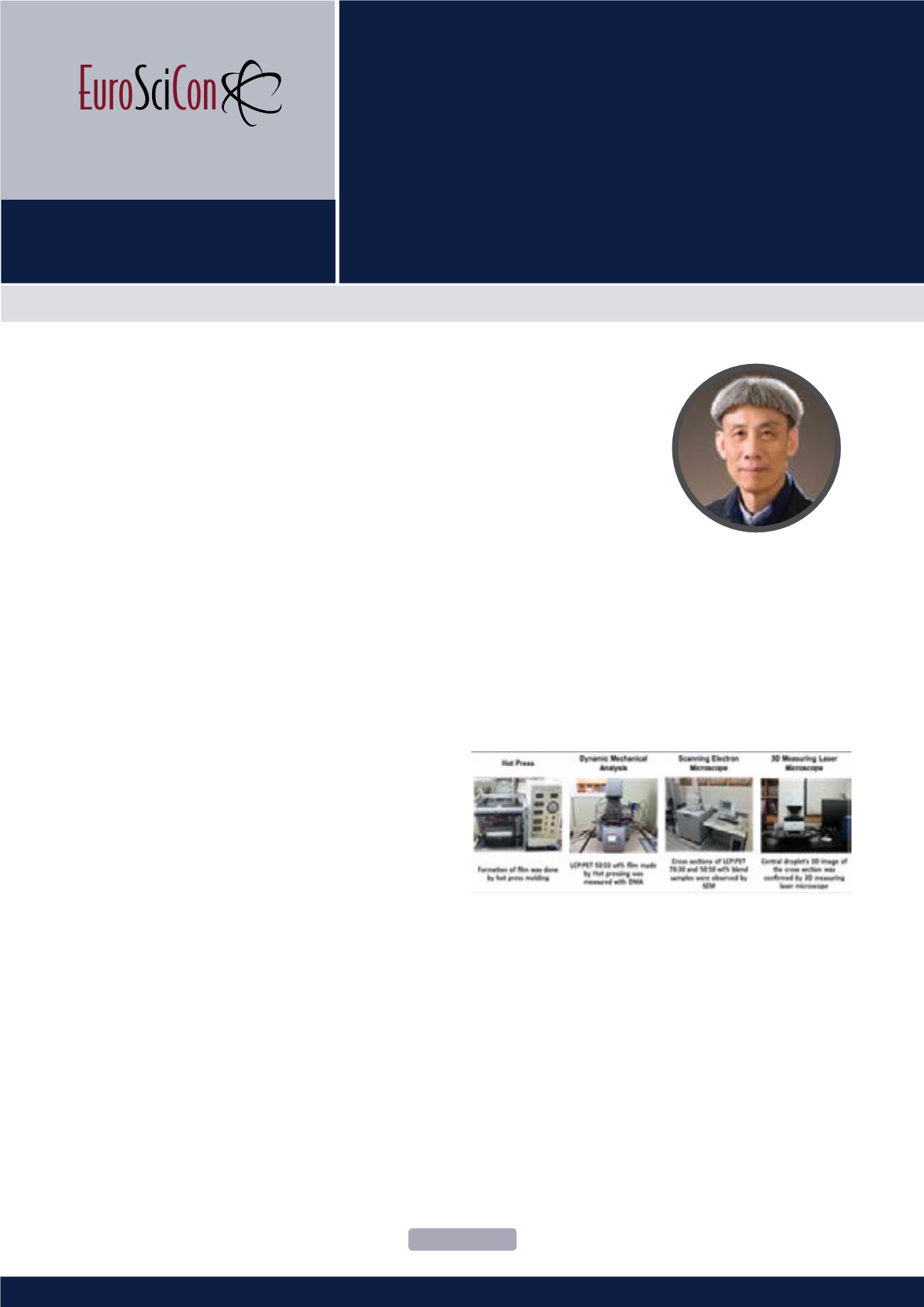
Figure 1:
Test equipment for LCP/PETdroplet behaviorby repeated extrusion