


 5 / 23

Volume 9
Journal of Neurology and Neuroscience
ISSN: 2171-6625
Page 17
JOINT EVENT
July 23-24, 2018 Birmingham, UK
&
24
th
International Conference on
Neuroscience and Neurochemistry
26
th
Edition of International Conference on
Clinical Psychology and Neuroscience
Nikolaus Blatter et al., J Neurol Neurosci 2018, Volume 9
DOI: 10.21767/2171-6625-C2-011
The effect of the C.O.M.E program for people with mental and/or drug disorders to live a more
independent life
Nikolaus Blatter, Harald R Bliem
and
M Mag Silvia Blatter
University of Innsbruck, Austria
I
n Austria many service provider offers a home treatment service. However, in most concepts housing depends on treatment.
The innovation of the home treatment service in Vorarlberg since 2015 is that the home treatment is separated from housing.
The long term-study started in the year 2016 and includes 52 probands from four service providers which offer a home-
treatment for people with mental or drug disorders and other social needs. Based on the theoretical foundation of Housing
First and Treatment First we developed the C.O.M.E Program which contains Cooperation, Observation, Mutual-support and
Evaluation. The focus of the study is to evaluate if the C.O.M.E Program supports the service provider in their (daily) care-
work and secondly, if it detects the individual-focused care supports the clients to gain a life with more autonomy, increase
permanent housing, decrease stays in hospital, improve a long-term mental stability and encourage them in the development
of alternative assistance for mutual support. To implement the program it was necessary to introduce the service provider into
the theoretical, differences and practical aspects of Housing First, Treatment First and the purpose of the C.O.M.E Program.
A crucial part of the data collection is done by the assessment sheet which is scored at least one time a week and correspond
with the hometreatment basic learning skills which the caregiver try to convey the clients. For further analysis the items of the
assessment sheet are combined to four dimensions: houshold management, personal hygiene, activity (social), psychosocial-
stability. Over a time-period of 40 weeks we found that continuous abstinence from drugs and alcohol is another important
criterion for a better cooperation between client and caregiver, but it is not necessarily a requirement to get a care-giver-
support. The execution is designed and conducted that the clients are demanded as much as possible and as less as necessary
in their daily life. Finally, it is necessary to keep the contact, even if the client denies the contact.
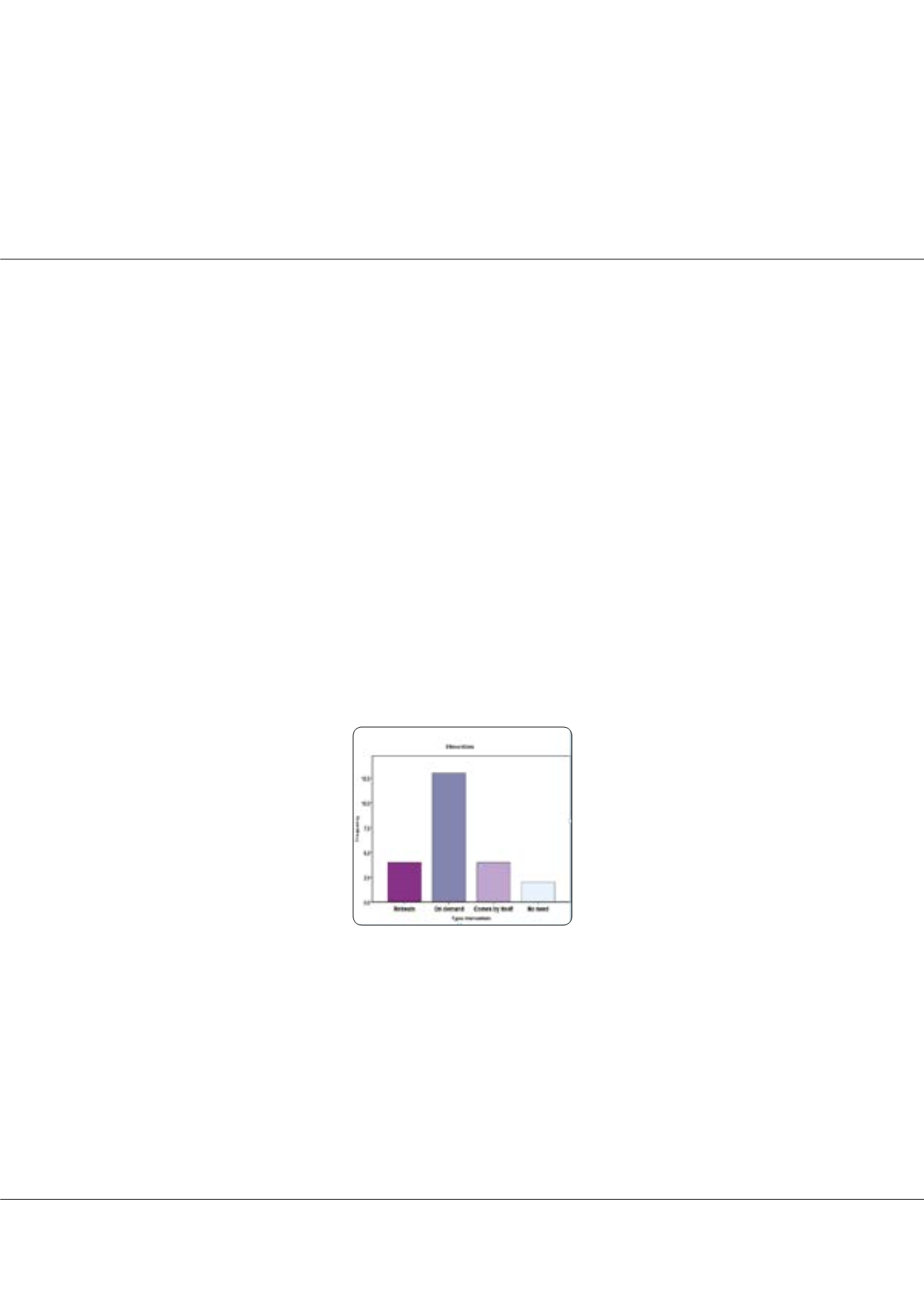
Figure 1:
Shows on the y-axis the frequency of the Intervention or contacts of one client over a 40 week period. The x-axis describes the types of Interventions.
In times of crisis,relapeses or withdrawal, the care-giver increase the frequency of Interventions and hold at least contact on a low level.
Recent Publications
1. Pearson, C., Montgomery, A.E., Locke, Gretchen. (2009). Housing stability among homeless individuals with
serious mental illness participating in housing first programs. In Wiley Inter Science [Electronic Version]. Journal
of community psychology, 77 (3), 404-417.
2. S. E. Collins, D. K. Malone, S. L. Clifasefi and J. A. Ginzler, "Project-Based Housing First for Chronically Homeless
Individuals With Alcohol Problems: Within-Subjects Analyses of 2-Year Alcohol Trajectories," vol. 102, no. 3, 2012.
3. Johnson, S. & Teixeira L. (2010). Staircases, Elevators and Cycles of Change – “Housing first” and other housing
models for homeless people with complex support needs. London: Crisis. ISBN: 978-1-899257-63-8
4. Sahlin I (2002) The staircase of transition: survival through failure. Innovation, European Journal of Social Research
18(2):115-135.