



 10 / 23

Volume 9
Journal of Neurology and Neuroscience
ISSN: 2171-6625
Page 22
JOINT EVENT
July 23-24, 2018 Birmingham, UK
&
24
th
International Conference on
Neuroscience and Neurochemistry
26
th
Edition of International Conference on
Clinical Psychology and Neuroscience
Takaki Shimura et al., J Neurol Neurosci 2018, Volume 9
DOI: 10.21767/2171-6625-C2-011
A neuropsychological test (CKPT: Color Word Pick-out Test) to be able to detect the slight disorder
of prefrontal lobe: Classify the level of the preclinical stage of dementia
Takaki Shimura
1
, Eriko Okuyama
2
and
Hironori Osugi
3
1
Sosei Group Corporation, Japan
2
Hamamatsu Photonics, Japan
3
Josai International University, Japan
F
inal goal of this research is to classify the levels of preclinical stage of dementia. A neuropsychological test named CKPT
(color word pick-out test) was invented for the purpose under the consideration that the test should be able to detect the
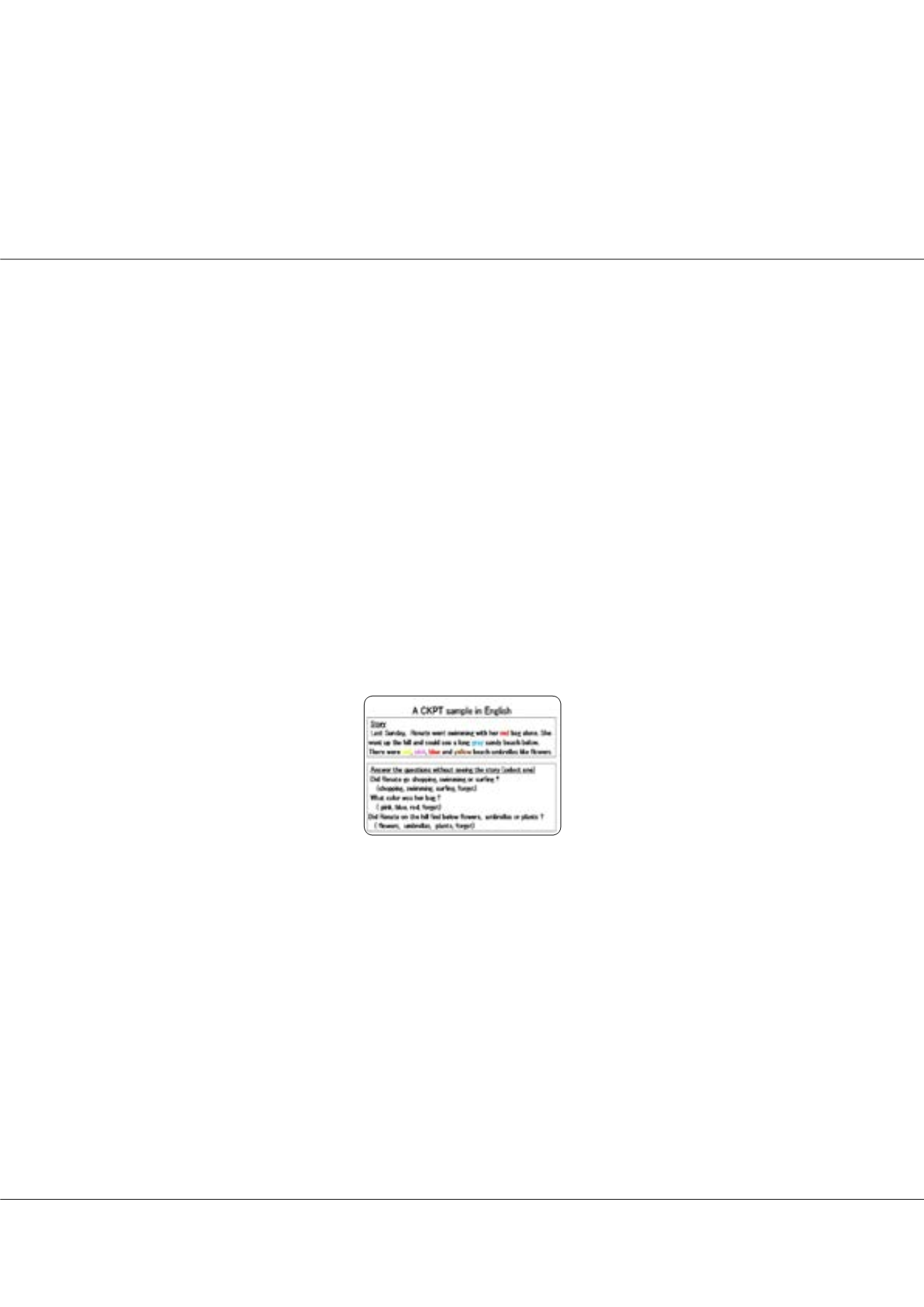
slight disorder of prefrontal lobe. The test was composed of two tasks. At the first task, a subject reads a story including color
words which are printed by different color, picking-out them and checking if the meaning of the color and printed color
is correspondent or not. It is an application of Stroop effect. For the second task the subject answers the questions about
the episode of the story without seeing it. Namely he must pick-up color words and memorizes the episode of the story
simultaneously. Prefrontal lobe measurements using near infrared spectroscopy recognize that CKPT activated prefrontal lobe
more than Kawashima arithmetic drill, recalling 5 numbers in order and recalling 5 numbers in inverse order. Comparison of
Ritchie check list, MMSE (mini mental state examination), FAB (frontal assessment battery), WCST (Wisconsin card sorting
test) was done for the ordinary elderly as criterion-related validity of CKPT. Correlation between CKPT and WCST was
recognized. And also the shape of the histograms of CKPT and WCST showed normal distribution. CKPT and MMSE were
applied to the abnormal elderly whose MMSE was under 27. Their score of CKPT remained almost under the average-1.5SD.
About 5000 elderly took CKPT and the results were used to make the criterion of CKPT. Now we would like to get some
collaborating partners who want to translate CKPT in other language.
Recent Publications
1. Jack Jr C R, Knopman D S, Jagust W J, et al., (2010) Hypothetical model of dynamic biomarkers of the Alzheimer’s
pathological cascade. Lancet Neurol 9:119-128.
2. Stroop J R (1935) Studies of interference in serial verbal reactions. Journal of Experimental Psychology 18(6):643-
662.
3. T Shimura et al. (2009) Prefrontal lobe measurement using near infrared spectroscopy- evaluation of early detection
methods and rehabilitation methods of dementia 107-118.
4. E Okuyama et al (2013) Analysis of criterion-related validity of CKPT. Journal of Japan society for early stage of
dementia 6 (1):90-97.
Biography
Takaki Shimura worked in the field of Biomedical Engineering at Fujitsu Laboratories Ltd., developing and researching ultrasound imaging, MRI, bio-magnetics
measurement by SQUID, X-ray imaging by flat panel detector, remote health care system by TV telephone and so on from 1969 to 2000. He worked at Tokai
University as a Professor, researching mainly BME on dementia, such as the prefrontal lobe imaging using infrared spectroscopy and neuropsychological tests for
early stage of dementia from 2000 to 2007. He founds daycare service houses at Sosei Ltd to apply his inventions of the brain rehabilitation to the elderly by himself
since 2009. He is the Engineering Fellow of the Japan Society of Ultrasound in Medicine, the President of Japan Society for Early Stage of Dementia formerly and
the chairman of BME on Dementia Group of the Japanese Society for Medical and Biological Engineering.
tshimura@tuba.ocn.ne.jp