


 5 / 6
5 / 6

Journal of Infectious Diseases and Treatment
ISSN: 2472-1093
Clinical Pathology & Epidemiology 2019
Page 42
Clinical Pathology and Epidemiology
February 27-28, 2019 | Prague, Czech Republic
7
th
Euroscicon Conference on
C
zech Republic has a long history of capacity building in public health
and epidemiology included. Since its accession to European Union
in 2004, the Czech Republic participates in training activities delivered by
European Centre for Disease Prevention and Control (ECDC). This training of
epidemiologists is primarily organized by the Public health Training Section
of the Public Health Capacity and Communication Unit. European Program
for Interventional Epidemiology Training–EPIET is its major activity. Together
with EPIET, the European program for public health microbiology training-
EUPHEM is organized. EPIET originated in 1995 in response to the need for
epidemiologists at European level with field epidemiology and international
expertise. Being a grant project in 2007, it became a sustainable programme
of ECDC. The program continues a capacity building to respond to new and
re-emerging threats of communicable diseases. EPIET is two-year learning
by doing fellowship program for European Union Member States (http://
www.epiet.org). ECDC has developed, in cooperation with epidemiologists
of the EUmember states, a set of core competencies and skills requirements
for epidemiologists. EPIET programme reflects these competences in the
field of surveillance, surveys, outbreak investigations, field studies, scientific
communication and education. Many of these competencies coincide with
the professional competencies gained by epidemiologists in the Czech
Republic in Postgraduate education. From 1995 to 2017, 546 fellows
graduated from the EPIET-EUPHEM programme. Sixty six fellows from
Eastern and Central European countries participated between 2004 and
2017. Czech Republic contributed with six fellows, five epidemiologists and
one microbiologist. Further more than 90 professionals from CR attended
ECDC sort courses. Number of graduated fellows and participants in courses
as well as facilitators and teachers build a considerable critical capacity to
address health threats within the country and in cross border reactions.
Field epidemiology training of
epidemiologists in the Czech
Republic in frame of the ECDC
training activities
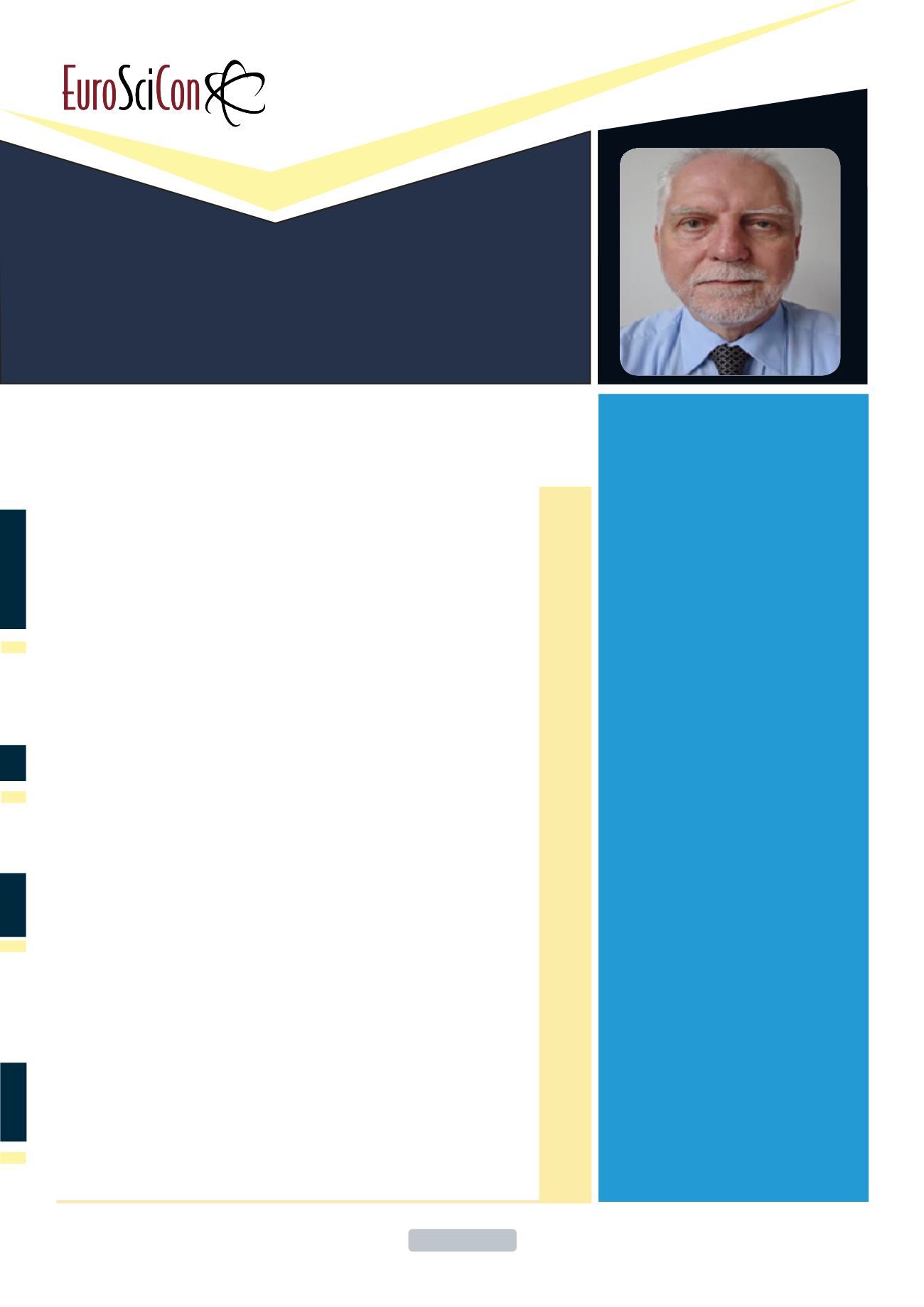
Vladimir Prikazsky
1
and A. Petrakova
2
1
National Institute of Public Health, Czech Republic
2
Palacky University, Czech Republic
Biography
Vladimir Prikazsky (CSc) has graduated from
Medical Faculty of Hygiene of the Charles
University in Prague in 1981. He has completed his
Postgraduate studies in Medical Microbiology in
1987 and the PhD in 1991 fromComenius University
in Bratislava. He worked in NIPH in Bratislava dealing
with Epidemiology of Resistance to Antibiotics. In
National Institute of Public Health in Prague, he
was charged with epidemiology of tuberculosis and
general epidemiology. He worked in ECDC focusing
on education and training of epidemiologists in
Europe and in Mediterranean region from 2007 to
2018. Currently, he is a Deputy Director for scientific
affairs in NIPH in Prague. He has published more
than 40 papers in various journals and co-authored a
textbook of epidemiology in Slovakia.
vladimir.prikazsky@szu.czVladimir Prikazsky et al, J Infec Dis Treat 2019, Volume: 5
DOI: 10.21767/2472-1093-C1-007