


 3 / 31

Page 49
Notes:
conferenceseries
.com
Polymer Sciences | ISSN: 2471-9935
October 02-03, 2017 Chicago, USA
3
rd
International Conference on
Polymer Science and Engineering
The synthesis and structure of olygomers based on phenol-formaldehyde resins and montmorrilonite, the
influence of concentration and acidity on their structures
Denys O Savchenko, Eugene O. Paschenko, Andrey N. Chernenko, Olga V. Lazhevskaya, Vyacheslav. V. Bichihin
and
Nikolay N. Nekoval
V. Bakul Institute for Superhard Materials, Ukraine
I
ntroduction: Montmorrilonite is one of the fillers for polymers that are studied now. It attracts scientists due to the following
reasons: 1) improvement of polymeric materials properties due to filler introducing 2) particularities of montmorrilonite behavior
in polymer melts and solutions 3) abundance and availability of the mineral Introduction of montmorrilonite into polymers and
olygomers may improve their mechanical properties, heat-resistance, gas selectivity (for membranes), compatibility of polymers, and
accelerate relaxation process and reduce water absorption. Polymeric composite materials based on montmorrilonite can be applied
for electrochemical sensors, drug delivery systems, packaging materials, sorbents, etc. However there are no literature data about
application of such polymeric composite materials as binders for grinding tools. In addition, there is no enough information about
structure peculiarities of olygomers based on phenol-formaldehyde, containing montmorrilonite. Objectives of this work were: 1)
to make the synthesis of olygomers based on phenol-formaldehyde and montmorrilonite, 2) to study olygomer structures and the
influence of concentration of montmorrilonite and alkali on them, 3) to provide a substantiate preposition about a chemical reaction
mechanism of olygomer formation. Experimental part: the synthesis of olygomers was conducted in seven steps: 1) the water was
added to montmorrilonite, 2) phenol-formaldehyde was dissolved in alkaline medium and a catalyst was added to it, 3) both mixtures
were heated and stirred during 30 days, 4) montmorrilonite sorbed the water was added in portions to the phenol-formaldehyde
solution 5) the obtained system was heated and stirred as well 6) during heating and stirring the residue of olygomer has formed
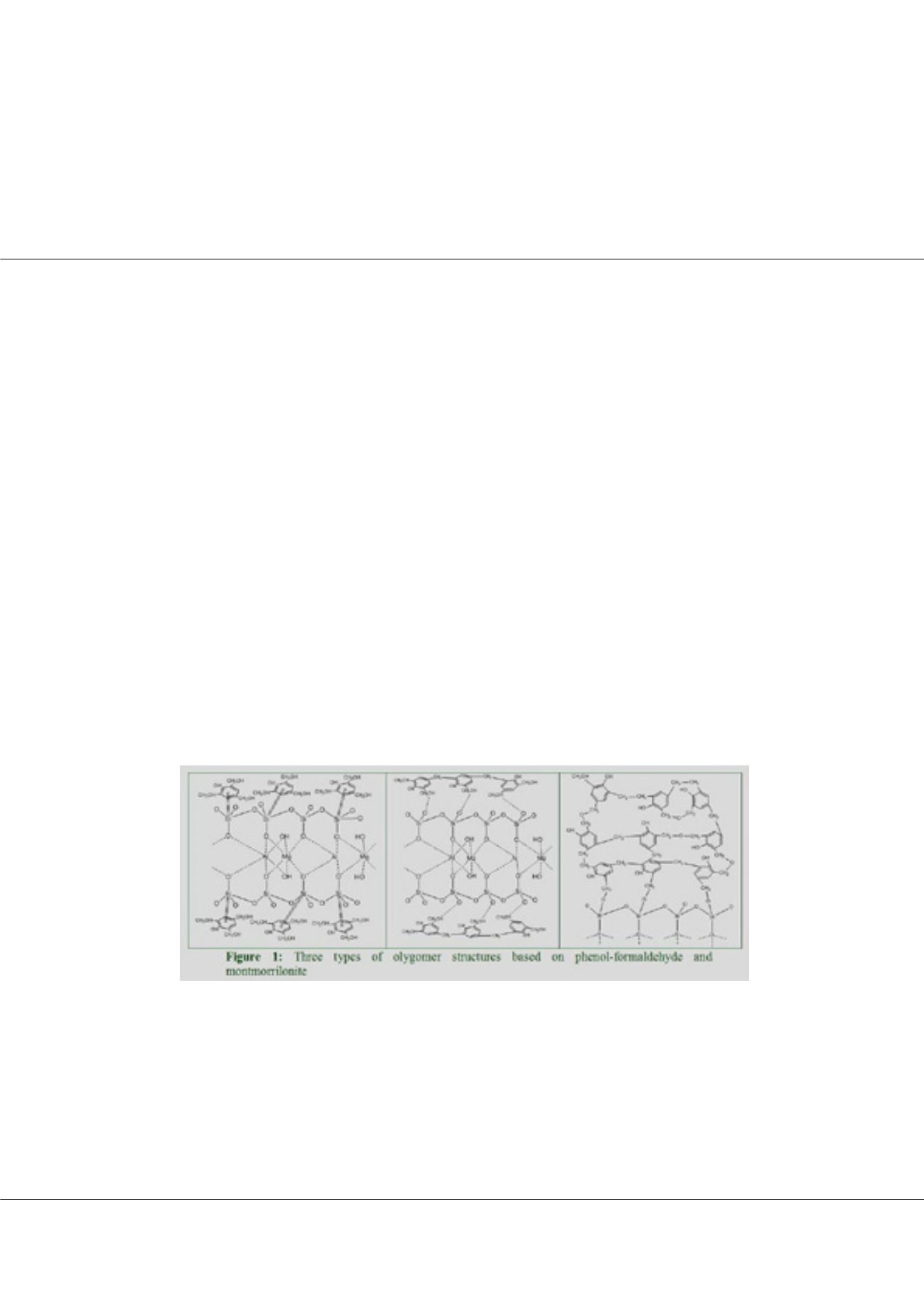
7) olygomer was filtered and dried. The structure of olygomer was studied with IR-spectra. Findings: Olygomers based on phenol-
formaldehyde, containing silica-alumina layers of montmorrilonite were synthesized. Synthesized olygomers were of three structure
types: 1) aromatic rings of phenol-formaldehyde are coordinated around silica atoms of silica-alumina layers 2) metoxyl and hydroxyl
groups are coordinated around silica-oxide groups of above mentioned layers 3) phenol-formaldehyde chains are chemically bound
with such layers via Si-O-C bonds.
Biography
Denys Savchenko is a passionate chemical researcher. He studies development of materials for grinding tools. In 2014 he got PhD in Material Sciences. His
research is dedicated to the study of the polymer structure and improvement of heat-resistance and mechanical properties of materials based on polymers.
denissavchenko@inbox.ruDenys O Savchenko et al., Polym Sci, 3:3
DOI: 10.4172/2471-9935-C1-003