



 19 / 23

Volume 9
Journal of Neurology and Neuroscience
ISSN: 2171-6625
Page 35
JOINT EVENT
July 23-24, 2018 Birmingham, UK
&
24
th
International Conference on
Neuroscience and Neurochemistry
26
th
Edition of International Conference on
Clinical Psychology and Neuroscience
Role of adipokines in enhanced pain and inflammation in a rodent model of obesity
Sharron Dolan
and
Nasser M AlorfI
Glasgow Caledonian University, UK
O
bese individuals are more likely to be affected by chronic pain, however, the biological mechanisms underpinning this
comorbidity are not known. A causal link may be dysregulated secretion of inflammatory adipokines both from expanding
adipose tissue and centrally. The aim of this study was to characterize altered pain processing and changes in inflammatory
cytokine expression in spinal cord in rodent models of obesity. Responses to thermal and mechanical stimulation of the hind
paw were assessed in adult male Wistar rats fed a high fat diet (HFD; 22%) or normal diet for 16 weeks (n=6/group) in
absence of inflammation, and then in response to intradermal hind paw injection of carrageenan (3%; 50μl), a model of acute
inflammation. Spinal cord was collected and adipokine mRNA expression, cholesterol and triglycerides (TAGs) measured
using real-time PCR and ELISA. Rats fed a HFD gained significantly more weight than controls (502 ± 12g vs. 444 ± 7g;
P<0.01), and displayed plasma hyperinsulaemia and hypercholesterolaemia (both P<0.05 vs. controls) but normoglycaemia.
Acute nociceptive responses were unchanged in obese rats but they displayed potentiated mechanical and thermal hyperalgesia
and increased paw edema (all P<0.05 vs. lean controls) in response to carrageenan. Significant changes in levels of resistin C
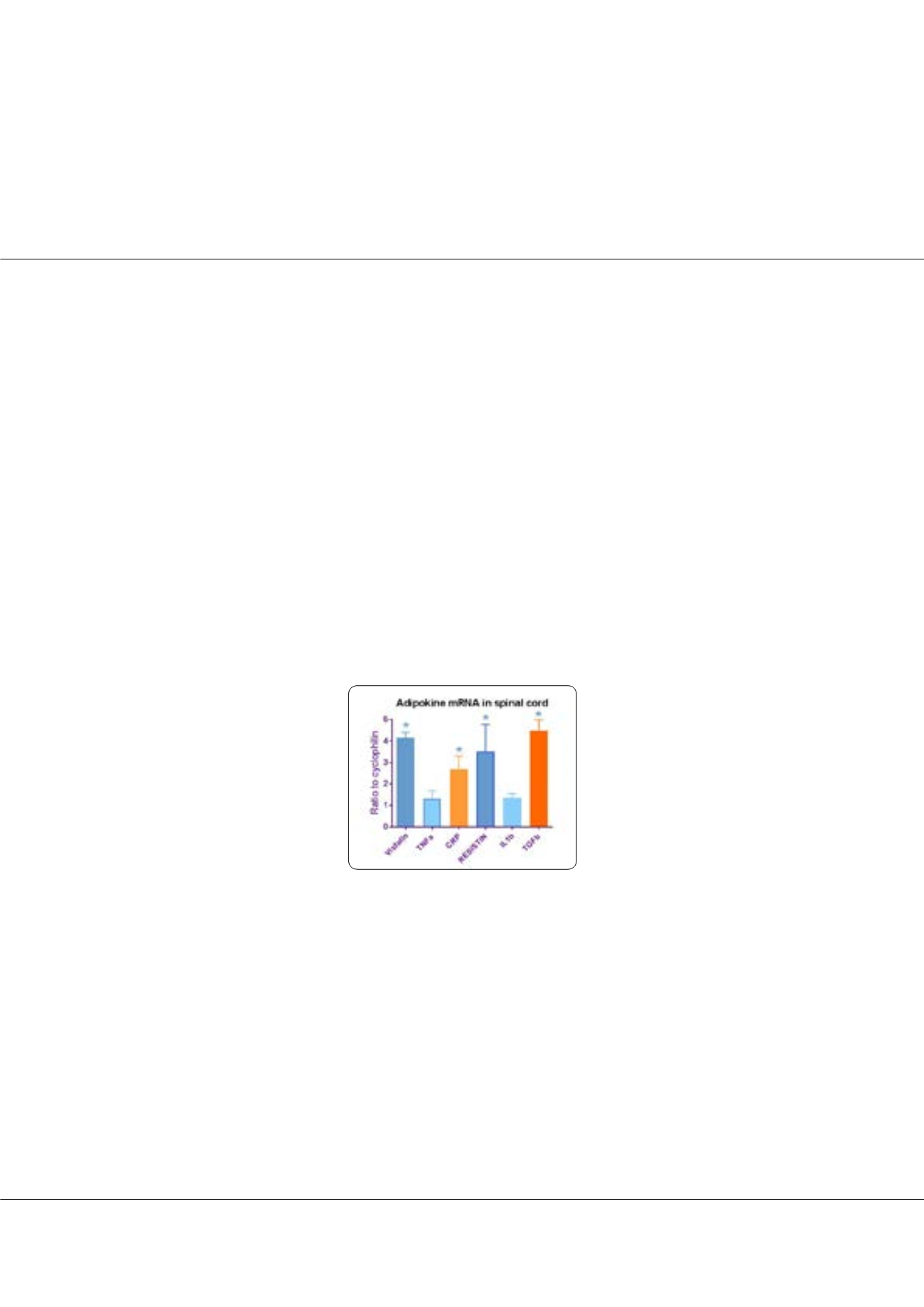
reactive protein, TGFβ and visfatin (but not IL1β or TNFβ) were detected in obese rat spinal cord. The increased pain and
inflammation in obese rats fits with the hypothesis that obesity is a chronic low-grade inflammatory disorder, producing a state
where responses to inflammatory challenge are potentiated. The altered adipokine profile observed suggests adipokines may
be useful biomarkers for monitoring initiation and progression of pain with obesity, or even be involved in the development of
co-morbid pain in obese individuals.
Real-time PCR analysis of adiopkine mRNA in spinal cord from HFD fed rats and control rats (n =6/group). Target mRNA are expressed relative to housekeeping
gene cyclophilin. Data are expressed as mean ± SEM. * p <0.05.
Recent Publications
1. Iannitti T, Graham A and Dolan S (2015) Adiponectin mediated analgesia and anti-inflammatory effects in rat. PLoS
One 10(9):e0136819.
2. Soffientini U, Dolan S and Graham A (2015) cytosolic lipid trafficking proteins stard4 and stard5 modulate hepatic
neutral lipid metabolism: implications for diabetic dyslipidemia and steatosis. Journal of Diabetes &Metabolism 6:558.
3. Soffientini U, Caridis A-M, Dolan S and Graham A (2014) Intracellular cholesterol transporters and modulation
of hepatic lipid metabolism: implications for diabetic dyslipidemia and steatosis. Biochimica et Biophysica Acta
1842(10):1372-82.
4. Goldie M and Dolan S (2013) Bilobalide, a unique constituent of Ginkgo biloba, inhibits inflammatory pain in rat.
Behavioral Pharmacology 24:298-306.
5. Iannitti T, GrahamAandDolan S (2012) Increased central and peripheral inflammation and inflammatory hyperalgesia
in Zucker rat model of leptin receptor deficiency and genetic obesity. Experimental Physiology 97 (11): 1236-45-
Sharron Dolan et al., J Neurol Neurosci 2018, Volume 9
DOI: 10.21767/2171-6625-C2-011